

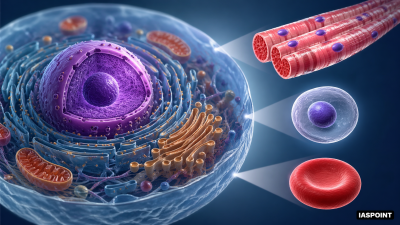
The nucleus is the most prominent organelle within a eukaryotic cell, serving as the repository of genetic information and the cell’s control center. Discovered by Robert Brown in 1831, it coordinates essential cellular activities including growth, metabolism, protein synthesis, and reproduction (cell division). While most cells are uninucleate, exceptions exist such as skeletal muscle cells (multinucleate) and mature human red blood cells (enucleate/lacking a nucleus).
Structural Components of the Nucleus
The nucleus is not a solid mass but a highly structured organelle composed of four primary parts:
Nuclear Envelope (Karyotheca)
- It is a double-membrane structure consisting of an outer and inner membrane separated by the perinuclear space.
- The outer membrane is often continuous with the Rough Endoplasmic Reticulum (RER) and may bear ribosomes.
- Nuclear Pores: These are minute passages formed by the fusion of the two membranes, acting as selective gates for the nucleo-cytoplasmic traffic of RNA and proteins.
Nucleoplasm (Nuclear Matrix)
- A transparent, semi-fluid ground substance containing enzymes (like DNA and RNA polymerases), metal ions, and nucleotides.
- It provides the medium for the suspension of chromatin and the nucleolus.
Nucleolus
- A non-membrane bound, spherical structure found within the nucleoplasm.
- It is the site of active ribosomal RNA (rRNA) synthesis.
- Cells involved in large-scale protein synthesis (e.g., liver cells) typically possess larger and more numerous nucleoli.
Chromatin
- A complex of DNA and basic proteins called histones, along with some non-histone proteins and RNA.
- During cell division, chromatin condenses to form highly structured bodies known as chromosomes.
Chromosomes: The Carriers of Heredity
Chromosomes are visible only during the stages of cell division. Every species has a fixed number of chromosomes (Humans: 46 chromosomes or 23 pairs).
Basic Structure of a Chromosome
- Centromere: The primary constriction where the two sister chromatids are held together.
- Kinetochore: Disc-shaped structures on the sides of the centromere to which spindle fibers attach during division.
- Telomere: The sealed ends of chromosomes that prevent DNA degradation and fusion with neighboring chromosomes.
Classification Based on Centromere Position
| Type | Centromere Position | Appearance during Anaphase |
| Metacentric | Middle; forms two equal arms. | V-shaped |
| Sub-metacentric | Slightly away from the middle; one shorter arm (p-arm) and one longer arm (q-arm). | L-shaped |
| Acrocentric | Near the end; results in one extremely short and one very long arm. | J-shaped |
| Telocentric | At the terminal end; only one arm is visible. | I-shaped |
Key Functions of the Nucleus
- Genetic Blueprint: It stores the hereditary information in the form of DNA, ensuring its transmission from one generation to the next.
- Transcriptional Control: It regulates gene expression by controlling which genes are transcribed into mRNA.
- Ribosome Production: The nucleolus synthesizes the components required for ribosomes, which are the protein factories of the cell.
- Cell Cycle Regulation: It initiates and governs the process of cell division (mitosis and meiosis).
Comparative Overview: Prokaryotic vs. Eukaryotic Nucleus
| Feature | Prokaryotic “Nucleus” (Nucleoid) | Eukaryotic Nucleus |
| Membrane | Absent; genetic material lies free in the cytoplasm. | Present; well-defined double membrane. |
| Shape of DNA | Generally circular. | Linear. |
| Histone Proteins | Absent. | Present (essential for DNA packaging). |
| Nucleolus | Absent. | Present. |
UPSC Prelims Fact File and Trivia
- Satellite Chromosomes (SAT): Some chromosomes possess a secondary constriction at a constant location, giving a small fragment appearance called a “satellite.” These are used as markers in genetic mapping.
- Acetabularia Experiment: Joachim Hämmerling’s experiments on the giant algae Acetabularia proved that the nucleus contains the hereditary information and determines the morphology of the cell.
- Chromatin Types: Euchromatin is loosely packed and transcriptionally active, while Heterochromatin is densely packed and transcriptionally inactive.
- Karyotype: This refers to the standard numerical and morphological appearance of the chromosomes in the nucleus of an eukaryotic cell. It is used to detect chromosomal abnormalities like Down Syndrome (Trisomy 21).