

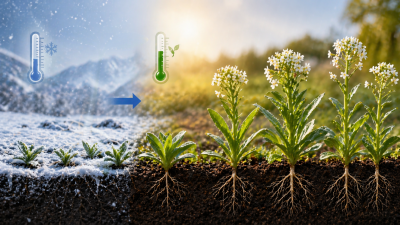
Vernalization is the process where the flowering of a plant is either quantitatively or qualitatively dependent on exposure to a low temperature. Derived from the Latin word vernus (meaning “of the spring”), it ensures that reproductive development and seed formation occur during favorable autumn and spring seasons rather than the harsh winter.
Physiological Mechanism
- Perception Site: The stimulus of low temperature is perceived by the shoot apex or the embryo of the seed, rather than the leaves.
- Hypothetical Hormone: It is believed that a hormone called Vernalin is produced in response to cold treatment, which is then transmitted to other parts of the plant to induce flowering.
- Epigenetic Regulation: At a molecular level, cold exposure leads to the silencing of flowering repressors (like the FLC gene in certain species), allowing the plant to transition from a vegetative to a reproductive state.
Types of Plants Exhibiting Vernalization
Vernalization is primarily observed in plants inhabiting temperate regions.
Winter and Spring Varieties
Many important food plants have two distinct varieties:
- Spring Varieties: These are planted in the spring and normally come to flower and produce grain before the end of the growing season.
- Winter Varieties: If planted in the spring, they fail to flower or produce mature grain within a span of a flowering season. They are planted in autumn, germinate, and over-winter as small seedlings. They resume growth in the spring and are harvested around mid-summer.
- Examples: Wheat, Barley, and Rye.
Biennial Plants
Biennials are monocarpic plants that normally flower and die in the second season.
- Growth Pattern: In the first year, they undergo vegetative growth (often forming a rosette of leaves); in the second year, after experiencing winter cold, they undergo bolting (internode elongation) and flowering.
- Examples: Sugar beet, Cabbage, and Carrots.
Difference Between Vernalization and Photoperiodism
| Feature | Vernalization | Photoperiodism |
| Stimulus | Low Temperature (Cold) | Duration of Light (Day length) |
| Perception Site | Shoot Apex / Meristematic cells | Mature Leaves |
| Primary Effect | Prepares the plant to flower | Actually initiates flowering |
| Nature of Stimulus | Chilling requirement | Light/Dark requirement |
Devernalization
The effect of vernalization can be reversed if the plant is exposed to high temperatures immediately following the cold treatment. This process is known as Devernalization. However, if the cold treatment is followed by a moderate temperature, the effect becomes permanent.
Practical Applications in Agriculture
- Shortening Vegetative Phase: It reduces the vegetative period of the plant, leading to early flowering and early harvest.
- Crop Improvement: It allows the cultivation of temperate crops in tropical or subtropical regions by providing artificial cold treatment to seeds.
- Breeding Programs: Enables breeders to obtain more than one crop per year in controlled environments.
UPSC Prelims Facts & Trivia
- Requirement: The ideal temperature for vernalization typically ranges between 1°C and 7°C.
- Requirement of Oxygen: Vernalization is an active metabolic process; therefore, a continuous supply of oxygen and water is necessary for the seeds to perceive the cold stimulus.
- Relationship with Gibberellins: In many biennial plants, the cold treatment (vernalization) can be replaced by the exogenous application of Gibberellins, which induces bolting and flowering.
- Monocarpic Nature: Most plants requiring vernalization are monocarpic, meaning they flower once and die, though some perennials also exhibit cold-dependency for flowering.