

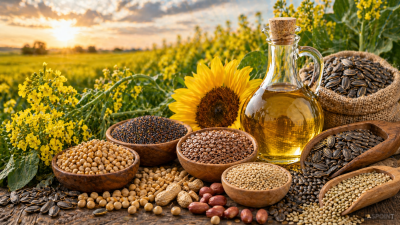
Oilseeds are crops grown primarily for the extraction of edible or industrial oils from their seeds or fruits.
Major Edible Oilseeds
Brassica species (Mustard and Rapeseed)
- Family: Brassicaceae (Cruciferae).
- Botanical Names: Brassica juncea (Indian Mustard/Rai), Brassica campestris (Yellow Sarson).
- Key Features: Characterized by tetradynamous stamens and a fruit called Siliqua.
- Oil Properties: Contains Erucic acid and Glucosinolates. High levels of erucic acid are considered a health risk, leading to the development of “Canola” (low erucic acid) varieties.
- Trivia: Pusa Jai Kisan (Bio-902) was the first somatic hybrid variety of mustard.
Arachis hypogaea (Groundnut)
- Family: Fabaceae.
- Botanical Oddity: It is a Geocarpic fruit. After pollination, the “peg” (stalk) grows downward into the soil where the pod matures.
- Nutritional Fact: Contains 25-30% protein and 45-50% oil.
- Toxin Alert: If stored in humid conditions, it can be infected by the fungus Aspergillus flavus, which produces Aflatoxin, a potent carcinogen.
Glycine max (Soybean)
- Family: Fabaceae.
- Dual Utility: Classified as both a pulse and an oilseed.
- Stats: Contains 20% oil and 40% protein.
- Economic Botany: It is the world’s most important source of vegetable oil and animal feed protein.
Helianthus annuus (Sunflower)
- Family: Asteraceae (Compositae).
- Botanical Feature: The inflorescence is a Capitulum (Head). It exhibits Heliotropism (tracking the sun).
- Health Fact: The oil is rich in Polyunsaturated Fatty Acids (PUFA), specifically Linoleic acid, which is beneficial for heart health as it lowers cholesterol.
Non-Traditional and Industrial Oilseeds
Ricinus communis (Castor)
- Family: Euphorbiaceae.
- Fruit: A regma with spines.
- Toxicity: The seed contains Ricin, one of the most poisonous naturally occurring proteins.
- Usage: The oil is non-edible and used as a high-grade lubricant, in medicines (purgative), and in the manufacture of soaps and plastics.
Sesamum indicum (Sesame/Til)
- Family: Pedaliaceae.
- Significance: Known as the “Queen of Oilseeds” due to its high resistance to oxidation and rancidity.
- Fact: Contains Sesamin and Sesamolin, which act as natural antioxidants.
Elaeis guineensis (Oil Palm)
- Family: Arecaceae (Palmae).
- Productivity: Highest oil yield per hectare among all oil crops.
- Distinction: Produces two types of oil: Palm oil (from the mesocarp) and Palm kernel oil (from the seed).
Comparison of Fatty Acid Profiles
| Oilseed | Primary Fatty Acid Type | Specific Acid | Usage |
| Sunflower | Polyunsaturated (PUFA) | Linoleic Acid | Heart-friendly edible oil |
| Coconut | Saturated | Lauric Acid | Cooking and Cosmetics |
| Castor | Monounsaturated | Ricinoleic Acid | Industrial Lubricant |
| Mustard | Monounsaturated | Erucic Acid | Cooking and Pickling |
UPSC Prelims: Important Facts and Missions
- National Mission on Edible Oils – Oil Palm (NMEO-OP): Launched to reduce import dependency, focusing particularly on the North-East and Andaman & Nicobar Islands.
- Yellow Revolution: Refers to the sudden increase in the production of oilseeds in India (launched in 1986-87).
- Solvent Extraction: A process where chemicals (like Hexane) are used to extract oil from oilseeds with low oil content or from the “cake” left after pressing.
- Oil Cake: The residue left after oil extraction. It is rich in protein and nitrogen, used as cattle feed or organic fertilizer.
- Dhara Mustard Hybrid-11 (DMH-11): A genetically modified (GM) mustard developed by Delhi University using the Barnase/Barstar system for hybridization.