

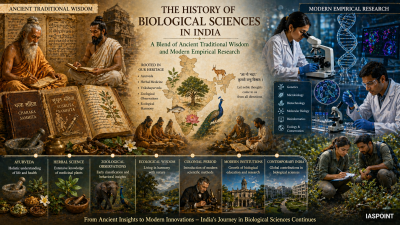
The history of biological sciences in India is a blend of ancient traditional wisdom and modern empirical research.
Pioneers of Plant and Animal Sciences
These scientists bridged the gap between physics and biology, proving that life processes are universal across species.
- Jagadish Chandra Bose (1858–1937):
- The Crescograph: Invented this highly sensitive device to measure plant growth and response to stimuli (light, sound, electricity).
- Plant Sensitivity: He was the first to prove that plants have a circulatory system and feel sensations similar to animals, effectively pioneering the field of plant neurobiology.
- Birbal Sahni (1891–1949):
- Paleobotany: Known as the “Father of Indian Paleobotany.” He studied the plant fossils of the Indian subcontinent, particularly from the Rajmahal Hills.
- Gondwana Flora: His research provided crucial evidence for the continental drift theory by studying fossilized plants unique to the ancient Gondwana supercontinent.
- Salim Ali (1896–1987):
- Ornithology: Known as the “Birdman of India.” He conducted the first systematic bird surveys across India.
- Bharatpur Bird Sanctuary: He was instrumental in the establishment of the Keoladeo National Park (Bharatpur) and the preservation of the Silent Valley National Park.
Molecular Biology and Genetics
These scholars made breakthroughs in the “code of life,” often working at the intersection of biochemistry and medicine.
- Har Gobind Khorana (1922–2011):
- Genetic Code: Shared the 1968 Nobel Prize in Physiology or Medicine for deciphering the genetic code and its function in protein synthesis.
- Synthetic Gene: He was the first to chemically synthesize an artificial gene in a laboratory setting.
- G.N. Ramachandran (1922–2001):
- Ramachandran Plot: A fundamental tool in structural biology used to understand the allowed conformations of peptide chains in protein structures.
- Collagen Structure: He proposed the triple-helical structure of collagen, the most abundant protein in mammals.
- Venkatraman Ramakrishnan (b. 1952):
- Ribosome Structure: Awarded the 2009 Nobel Prize in Chemistry for mapping the structure of the ribosome at the atomic level, which is crucial for understanding how antibiotics work.
- Lalji Singh (1947–2017):
- DNA Fingerprinting: Known as the “Father of Indian DNA Fingerprinting.” He developed the first indigenous probe for DNA fingerprinting (BKM-derived) for forensic and wildlife conservation use in India.
Agriculture and Medicine
Biological contributions in these fields directly addressed India’s national challenges like food security and infectious diseases.
- M.S. Swaminathan (1925–2023):
- Green Revolution: The “Father of Economic Ecology.” He introduced High-Yielding Varieties (HYV) of wheat and rice to India, transforming the country from a “begging bowl” to a self-sufficient nation.
- Janaki Ammal (1897–1984):
- Cytogenetics: A pioneering woman botanist who worked on the genetic composition of sugarcane and eggplants. Her work led to the development of the “sweet” Indian sugarcane variety.
- Dilip Mahalanabis (1934–2022):
- Oral Rehydration Solution (ORS): During the 1971 Bangladesh Liberation War, he proved the efficacy of ORS in treating cholera. The Lancet called it the most important medical discovery of the 20th century.
- Yellapragada Subbarao (1894–1948):
- Aureomycin: He discovered the first tetracycline antibiotic, Aureomycin. He also synthesized Folic Acid (crucial for treating anemia) and Methotrexate (a foundational chemotherapy drug).
Contemporary Biologists and Researchers
Current leaders in Indian biology are focusing on genomics, cell signaling, and public health.
| Scientist | Field of Specialization | Notable Achievement |
| Satyajit Mayor | Cell Biology | Research on cell membrane organization and signaling at NCBS. |
| Soumya Swaminathan | Clinical Research | Former Chief Scientist at WHO; expert in tuberculosis and HIV research. |
| K. VijayRaghavan | Developmental Biology | Known for work on the genetics of the nervous system and muscles in Drosophila. |
| Gagandeep Kang | Virology | First Indian woman to be elected a Fellow of the Royal Society; key figure in Rotavirus vaccine development. |
Key Facts for UPSC Prelims
- Shanti Swarup Bhatnagar Prize: The highest scientific award in India, with a specific category for “Biological Sciences.”
- TIFR and NCBS: The Tata Institute of Fundamental Research (Mumbai) and the National Centre for Biological Sciences (Bengaluru) are the premier hubs for biological research in India.
- Indigenous Vaccine Milestone: India’s successful development of Covaxin (Bharat Biotech) and ZyCoV-D (Zydus Cadila—the world’s first DNA vaccine) represents the peak of modern Indian biological engineering.