

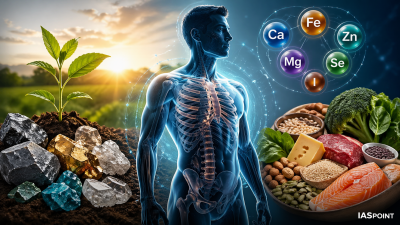
Minerals are inorganic elements required by the body in small amounts to perform various metabolic, structural, and regulatory functions. Unlike vitamins, minerals are chemical elements that cannot be synthesized by living organisms and must be absorbed from the soil by plants or ingested through diet by animals. They constitute approximately 4% of human body weight.
Classification of Minerals
Based on the daily requirement, minerals are divided into two categories:
1. Macro-minerals (Major Minerals)
Required in quantities greater than 100 mg/day. These are essential for structural integrity and osmotic balance.
- Examples: Calcium (Ca), Phosphorus (P), Potassium (K), Sulfur (S), Sodium (Na), Chlorine (Cl), and Magnesium (Mg).
2. Micro-minerals (Trace Elements)
Required in quantities less than 100 mg/day, often in micrograms (μ g). These usually act as cofactors for enzymes.
- Examples: Iron (Fe), Iodine (I), Zinc (Zn), Copper (Cu), Fluorine (F), Selenium (Se), and Manganese (Mn).
Detailed Mineral Profile and Physiological Roles
| Mineral | Key Functions | Major Sources | Deficiency / Toxicity |
| Calcium (Ca) | Bone/teeth formation, Blood clotting, Muscle contraction. | Milk, Green leafy vegetables, Ragi. | Rickets, Osteoporosis, Hypocalcemia. |
| Phosphorus (P) | Formation of ATP, DNA, RNA; Bone structure. | Meat, Beans, Whole grains. | Weakness, Bone pain. |
| Iron (Fe) | Constituent of Hemoglobin and Myoglobin; Oxygen transport. | Spinach, Jaggery, Liver, Apples. | Anemia (Reduced oxygen carrying capacity). |
| Iodine (I) | Synthesis of Thyroxine hormone by Thyroid gland. | Iodized salt, Seafood. | Goitre, Cretinism (in children). |
| Sodium (Na) | Osmotic balance, Nerve impulse conduction. | Common salt, Celery. | Hyponatremia, Muscle cramps. |
| Potassium (K) | Nerve transmission, Heart rhythm, Stomatal opening (Plants). | Bananas, Potatoes, Coconut water. | Hypokalemia, Cardiac arrest. |
| Fluorine (F) | Maintenance of tooth enamel. | Water, Seafood. | Dental caries (Deficiency); Fluorosis (Excess). |
| Zinc (Zn) | Enzyme cofactor (Carbonic anhydrase), Wound healing. | Nuts, Whole grains, Meat. | Delayed wound healing, Loss of taste. |
| Magnesium (Mg) | Chlorophyll component (Plants); Ribosome stability. | Green vegetables, Nuts. | Chlorosis in plants; Convulsions in humans. |
Specific Biochemical Mechanisms
- Iron in Heme: Iron exists in the Fe2+ (Ferrous) state within the porphyrin ring of hemoglobin to reversibly bind Oxygen.
- Sodium-Potassium Pump (Na^+/K^+ ATPase): A vital active transport mechanism that maintains the resting membrane potential in neurons, consuming approx. 30% of a cell’s ATP.
- Calcium as a Second Messenger: Calcium ions (Ca2+) act as intracellular signals to trigger neurotransmitter release and muscle fiber sliding (via Troponin).
- Cobalt in B12: Cobalt is a central component of the Vitamin B12 (Cyanocobalamin) molecule, essential for RBC maturation.
Minerals in Plants (Special Mention for UPSC)
Plants require 17 essential elements.
- Critical Elements: Nitrogen (N), Phosphorus (P), and Potassium (K) — often referred to as NPK.
- Chlorosis: Yellowing of leaves due to lack of Chlorophyll (deficiency of Mg, Fe, or N).
- Necrosis: Death of leaf tissue (deficiency of Ca, Mg, Cu, or K).
UPSC Prelims Fact File
- Universal Solvent Link: Water’s high dielectric constant allows it to dissolve and transport these minerals as ions (Na^+, Cl^-, etc.).
- Chelation: The process where organic molecules bind to mineral ions (e.g., Hemoglobin is a chelate of Iron; Chlorophyll is a chelate of Magnesium).
- Biofortification: Breeding crops to increase their nutritional value, such as Iron-fortified pearl millet to fight anemia.
- Electrolytes: Sodium, Potassium, and Chloride are the primary electrolytes that maintain the body’s fluid balance and pH.
- Heavy Metal Toxicity: While trace minerals are essential, heavy metals like Lead (Pb), Mercury (Hg), and Arsenic (As) are toxic as they mimic essential minerals and displace them in enzymes.
- Minamata Disease: Caused by Mercury poisoning.
- Itai-Itai Disease: Caused by Cadmium poisoning.
Summary Table: Minerals as Enzyme Cofactors
| Enzyme | Mineral Cofactor |
| Carbonic Anhydrase | Zinc (Zn2+) |
| Catalase / Peroxidase | Iron (Fe2+/Fe3+) |
| Urease | Nickel (Ni2+) |
| Salivary Amylase | Chloride (Cl^-) |
| Nitrogenase | Molybdenum (Mo) |