

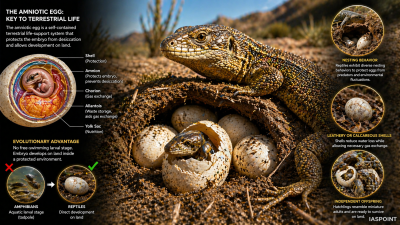
The reproductive strategy of reptiles marks the definitive transition from aquatic dependency to a terrestrial existence. The evolution of the amniotic egg is the most significant milestone, allowing reptiles to bypass the larval (tadpole) stage seen in amphibians.
Reproductive Anatomy and Fertilization
- Dioecious Nature: Reptiles have distinct male and female individuals. Sexual dimorphism is common, where males and females may differ in size, color, or secondary sexual characteristics (e.g., the “Ghara” in male Gharials).
- Internal Fertilization: To prevent gametes from drying out on land, fertilization occurs inside the female’s body.
- Copulatory Organs: * Hemipenes: Snakes and lizards possess paired copulatory organs called hemipenes, though only one is used during a single mating event.
- Single Penis: Crocodilians and turtles possess a single, mid-ventral penis.
- Cloaca: Both sexes possess a cloaca, a common chamber where the reproductive, digestive, and urinary tracts terminate.
The Amniotic Egg: A Terrestrial Innovation
The reptilian egg is a self-contained life-support system. It is usually cleidoic (closed/shell-bound) and macrolecithal (contains a large amount of yolk).
Extra-Embryonic Membranes
- Amnion: A fluid-filled sac that surrounds and cushions the embryo, providing an aquatic environment on land.
- Yolk Sac: Contains the yolk, providing the embryo with necessary nutrients for growth.
- Allantois: Acts as a respiratory organ and a “trash can” for nitrogenous waste (uric acid).
- Chorion: The outermost membrane that facilitates gas exchange between the embryo and the outside air.
- The Shell: Can be leathery (snakes/lizards) or calcareous/hard (turtles/crocodiles), providing protection while remaining porous enough for oxygen to enter.
Parity and Development Modes
Reptiles exhibit various modes of bringing forth young:
- Oviparity (Egg-laying): The most common mode. Females lay eggs in nests or burrows, and the embryos develop outside the mother’s body. (Examples: Turtles, Crocodiles, Cobras).
- Ovoviviparity: Eggs are retained inside the mother’s body until they are ready to hatch. There is no placental connection; the embryo depends on the egg yolk. (Examples: Many Vipers and Sea Snakes).
- Viviparity (Live-birth): A rare condition in reptiles where a placenta-like connection develops between the mother and the embryo. (Examples: Certain species of Skinks and Boas).
Temperature-Dependent Sex Determination (TSD)
In many reptiles, the sex of the offspring is not determined by sex chromosomes (X and Y) but by the ambient temperature during a critical period of embryonic development.
| Group | Low Temperature Trend | High Temperature Trend |
| Most Turtles | Produces Males | Produces Females |
| Crocodilians | Produces Females | Produces Males |
| Lizards | Varies by species | Varies by species |
Prelims Trivia: This phenomenon makes reptiles particularly vulnerable to Climate Change, as rising global temperatures can lead to extreme sex-ratio imbalances in wild populations.
Post-Embryonic Development
- Direct Development: Unlike amphibians, reptiles do not undergo metamorphosis. The young hatch as miniature versions of the adults (hatchlings).
- Egg Tooth: Hatchlings of many species possess a temporary “egg tooth” (caruncle) on their snout to help them break through the tough eggshell.
- Parental Care: Generally minimal in most reptiles. However, Crocodilians are a notable exception; mothers often guard the nest and carry the hatchlings to the water in their mouths, protecting them for several months.
Parthenogenesis: Reproduction without Males
In a few specialized groups, such as certain species of Whiptail Lizards and the Brahminy Blind Snake, reproduction can occur without fertilization.
- This is known as Parthenogenesis.
- The entire population consists of females who produce genetically identical female offspring.
- It is an adaptation for colonizing new habitats where finding a mate might be difficult.
Reproductive Statistics of Indian Reptiles
| Species | Parity | Clutch Size / Litter | Notable Fact |
| King Cobra | Oviparous | 20–40 eggs | Only snake to build an actual nest. |
| Olive Ridley Turtle | Oviparous | 100–120 eggs | Practices Arribada (mass nesting). |
| Russell’s Viper | Ovoviviparous | 20–40 young | Gives birth to live young. |
| Gharial | Oviparous | 30–50 eggs | Males use “Ghara” to create bubbles during courtship. |