

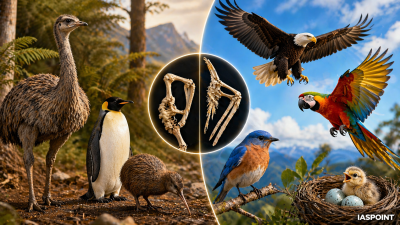
Class Aves is divided into two primary subclasses based on evolutionary history and skeletal structures.
- Subclass Archaeornithes: Extinct primitive birds from the Jurassic period. They possessed reptilian features such as teeth and a long bony tail. Example: Archaeopteryx (the connecting link between reptiles and birds).
- Subclass Neornithes: Includes all modern birds, both living and extinct, starting from the Post-Jurassic period. These birds have a short tail and lack teeth.
Major Divisions of Modern Birds (Neornithes)
Modern birds are further classified into two distinct superorders based on their breastbone (sternum) structure and flight capabilities.
1. Superorder Palaeognathae (Ratitae)
These are flightless birds characterized by a flat, raft-like sternum that lacks a keel (the ridge where flight muscles attach).
- Physical Traits: Strong legs for running, reduced wings, and a simplified feather structure.
- Geographic Distribution: Found primarily in the Southern Hemisphere (Gondwanan distribution).
- Representative Examples:
- Ostrich (Struthio): Largest living bird; two-toed.
- Kiwi (Apteryx): National symbol of New Zealand; unique for having nostrils at the tip of its beak.
- Penguin (Sphenisciformes): While flightless in the air, they are highly adapted for “flight” underwater using modified wings called flippers.
2. Superorder Neognathae (Carinatae)
This group includes almost all modern flying birds. They possess a keeled sternum (Carina) to support the massive pectoralis muscles required for flight.
- Physical Traits: Well-developed wings, specialized beak shapes for diverse diets, and complex syrinx for vocalization.
- Representative Orders:
- Passeriformes: Known as perching birds or songbirds (e.g., Sparrows, Crows, Weavers). This is the largest order of birds.
- Falconiformes/Accipitriformes: Birds of prey or Raptors (e.g., Eagles, Vultures, Hawks).
- Anseriformes: Waterfowl (e.g., Ducks, Geese, Swans).
Comparative Classification Table
| Feature | Ratitae (Flightless) | Carinatae (Flying) |
| Sternum | Flat, without a keel. | Keeled (Carina) for muscle attachment. |
| Wings | Rudimentary or vestigial. | Well-developed for flight. |
| Oil Gland | Usually absent (except Kiwi). | Present (Preen gland). |
| Syrinx | Absent. | Present (produces sound). |
| Distribution | Restricted (mostly Southern Hemisphere). | Cosmopolitan (found worldwide). |
Important Orders and Species for UPSC Prelims
Certain bird orders are frequently relevant due to their ecological status or presence in Indian conservation efforts.
Columbiformes (Pigeons and Doves)
- Fact: They produce “Crop Milk,” a secretion from the lining of the crop used to feed altricial young. Both males and females produce this.
Galliformes (Game Birds)
- Examples: Indian Peafowl, Red Jungle Fowl, Quails.
- Significance: Most are heavy-bodied ground feeders. The Red Jungle Fowl is the wild ancestor of the domestic chicken.
Coraciiformes (Kingfishers and Hornbills)
- Ecological Fact: Hornbills (e.g., Great Hornbill) are vital for tropical forest regeneration due to their role in dispersing large seeds.
Ciconiiformes (Wading Birds)
- Examples: Storks, Herons, Ibises.
- Habitat: Primarily wetlands; they serve as bio-indicators for the health of aquatic ecosystems under the Ramsar Convention.
Specialized Classifications based on Habitat and Diet
- Piscivorous Birds: Fish-eaters (e.g., Kingfishers, Pelicans, Cormorants).
- Frugivorous Birds: Fruit-eaters (e.g., Hornbills, Parrots).
- Insectivorous Birds: Insect-eaters (e.g., Drongos, Bee-eaters).
- Raptorial Birds: Carnivorous hunters with talons and hooked beaks (e.g., Peregrine Falcon).
Trivia for Competitive Exams
- Archaeopteryx: Often cited as the “Missing Link” because it displays reptilian features (teeth, long tail) and avian features (feathers, wings).
- The Swift: Capable of staying airborne for nearly ten months without landing, even sleeping while in flight.
- Hoatzin: A South American bird whose chicks have claws on their wings, a primitive trait reminiscent of ancestral bird species.