

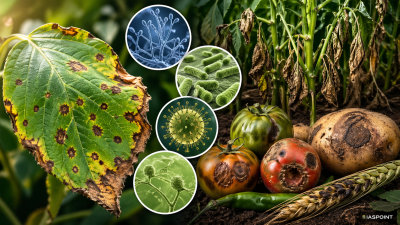
Plant diseases are a critical component of the UPSC Biology syllabus, specifically under the “Agriculture” and “Botany” segments. These diseases are primarily caused by fungi, bacteria, viruses, and phytoplasmas.
Rust Diseases (Fungal)
Rusts are among the most destructive fungal diseases, primarily affecting cereal crops and timber. They are caused by fungi in the order Pucciniales.
Characteristics and Mechanism
- Pathogen: Primarily the genus Puccinia.
- Symptoms: Appearance of powdery, rust-colored pustules (spores) on leaves, stems, and fruits. These pustules can be orange, yellow, brown, or black.
- Physiological Impact: They reduce the photosynthetic area of the leaf, leading to stunted growth and shriveled grains.
Major Examples
- Black Wheat Rust: Caused by Puccinia graminis tritici. It is known as the “famine of the wheat” due to its rapid spread.
- Coffee Rust: Caused by Hemileia vastatrix. It decimated coffee plantations in Sri Lanka in the 19th century.
- Cedar-Apple Rust: Caused by Gymnosporangium juniperi-virginianae, requiring two hosts to complete its life cycle.
Smut Diseases (Fungal)
Smuts are multicellular fungi characterized by their large numbers of dark, thick-walled, dust-like spores. They primarily affect the reproductive parts (seeds) of the plant.
Characteristics and Mechanism
- Pathogen: Primarily the genus Ustilago and Tilletia.
- Symptoms: Transformation of plant tissues (mostly grains) into black, powdery masses of spores called teliospores.
- Mode of Infection: Often systemic, where the fungus grows internally within the plant without showing symptoms until flowering.
Key Varieties
- Loose Smut of Wheat: Caused by Ustilago nuda. The entire grain is replaced by black soot.
- Whip Smut of Sugarcane: Caused by Sporisorium scitamineum, resulting in a black whip-like structure at the apex.
- Covered Smut of Barley: Caused by Ustilago hordei, where the spore mass remains covered by a thin membrane.
Blight Diseases (Fungal/Bacterial)
Blight refers to the rapid and complete chlorosis, browning, then death of plant tissues such as leaves, branches, and floral organs.
Major Types and Causative Agents
- Late Blight of Potato: Caused by the oomycete Phytophthora infestans. This was the primary cause of the Irish Potato Famine (1845).
- Early Blight of Potato/Tomato: Caused by Alternaria solani. Characterized by “target board” concentric rings on leaves.
- Bacterial Leaf Blight of Rice: Caused by Xanthomonas oryzae. It leads to yellowing and drying of leaves, significantly reducing yield in Asian countries.
Wilt Diseases (Fungal/Bacterial)
Wilt is a condition where plants lose their turgidity, causing leaves to droop and eventually die due to the blockage of the plant’s vascular system (Xylem).
Mechanism of Action
- Vascular Blockage: The pathogen enters the roots and multiplies in the xylem vessels, physically blocking the transport of water and nutrients.
- Toxin Production: Some pathogens produce phytotoxins that degrade the cell walls of the vascular tissue.
Common Examples
- Fusarium Wilt: Caused by Fusarium oxysporum. It affects a wide range of crops including bananas (Panama Disease), cotton, and tomatoes.
- Verticillium Wilt: A soil-borne fungal disease affecting over 300 eudicot species.
- Bacterial Wilt of Solanaceous Crops: Caused by Ralstonia solanacearum, affecting potatoes and eggplants.
Mosaic Diseases (Viral)
Mosaic diseases are caused by viruses and are characterized by mottling or “mosaic” patterns of light and dark green on the leaves.
Characteristics and Transmission
- Symptoms: Leaf curling, mottling, dwarfing, and vein clearing.
- Vectors: These viruses are rarely spread by wind; they require biological vectors such as Aphids, Whiteflies, or Leafhoppers.
- Systemic Nature: Once a virus infects a part of the plant, it typically spreads throughout the entire organism.
Significant Examples
- Tobacco Mosaic Virus (TMV): The first virus ever discovered. It affects tobacco and other solanaceous plants.
- Yellow Vein Mosaic of Bhindi (Okra): Transmitted by the Whitefly (Bemisia tabaci). It is a major constraint in Okra production in India.
- Cucumber Mosaic Virus (CMV): Has one of the broadest host ranges of any plant virus.
Summary Table of Plant Diseases for Quick Revision
| Disease Type | Primary Pathogen Group | Identifying Symptom | Key Example |
| Rust | Fungi (Basidiomycota) | Rusty, powdery pustules on leaves/stems | Wheat Rust (Puccinia) |
| Smut | Fungi (Basidiomycota) | Black, sooty spore masses in grains | Loose Smut of Wheat |
| Blight | Fungi / Bacteria | Rapid browning and death of tissue | Late Blight of Potato |
| Wilt | Fungi / Bacteria | Drooping due to xylem blockage | Panama Disease (Banana) |
| Mosaic | Virus | Mottled light/dark green leaf patterns | Tobacco Mosaic Virus |
Comparative Factsheet for UPSC Prelims
- Air-Borne Diseases: Rusts and certain Blights (spores travel via wind).
- Seed-Borne Diseases: Loose Smut of Wheat (pathogen remains dormant inside the seed).
- Soil-Borne Diseases: Fusarium Wilt and Root Rot (pathogens survive in the soil for years).
- Bordeaux Mixture: A famous fungicide consisting of Copper Sulfate and Lime, widely used to control Downy Mildew and Blights.
- Vector Control: Controlling Mosaic diseases usually requires the elimination of insects like Whiteflies and Aphids rather than the virus itself.