

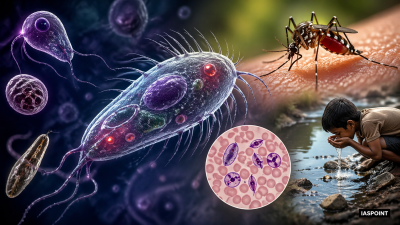
Protozoa are single-celled eukaryotic microorganisms that can live as parasites or free-living organisms. In the context of human pathology, parasitic protozoa are significant because they often utilize vectors (like mosquitoes or flies) or contaminated resources (water and food) to infect humans. Unlike viruses, protozoa are complex organisms, and diseases caused by them often become chronic if not treated with specific antiprotozoal medications.
Major Protozoan Diseases in Humans
The following table provides a concise reference for the most frequent protozoan infections, their causative agents, and transmission modes.
| Disease | Causative Agent (Protozoa) | Vector / Mode of Transmission | Primary Organ Affected |
| Malaria | Plasmodium spp. (P. falciparum, P. vivax) | Female Anopheles mosquito | Liver and Red Blood Cells (RBCs) |
| Amoebiasis | Entamoeba histolytica | Contaminated food and water | Large Intestine |
| Kala-azar | Leishmania donovani | Sandfly (Phlebotomus) | Liver, Spleen, Bone Marrow |
| Sleeping Sickness | Trypanosoma brucei | Tsetse fly | Central Nervous System |
| Chagas Disease | Trypanosoma cruzi | Triatomine bugs (“Kissing bugs”) | Heart and Digestive muscle |
| Giardiasis | Giardia lamblia | Contaminated water | Small Intestine |
| Trichomoniasis | Trichomonas vaginalis | Sexual contact | Genitourinary tract |
Malaria: A Comprehensive Profile
Malaria remains the most significant protozoan disease globally. It is caused by the Plasmodium parasite.
Life Cycle and Pathogenesis
The life cycle is dimorphic, requiring two hosts: the female Anopheles mosquito (primary host/vector) and humans (secondary host).
- Infection: Sporozoites are injected into the human bloodstream via a mosquito bite.
- Exo-erythrocytic Stage: Sporozoites migrate to the liver, multiply, and become merozoites.
- Erythrocytic Stage: Merozoites infect RBCs. When RBCs rupture, they release a toxic substance called Haemozoin, which causes the characteristic recurring chills and high fever.
Plasmodium Species
- P. falciparum: Causes malignant malaria; most fatal and common in sub-Saharan Africa and parts of India.
- P. vivax: Most widespread globally; causes benign tertian malaria.
- P. malariae / P. ovale: Less common variants.
Leishmaniasis (Kala-azar)
Also known as “Visceral Leishmaniasis” or “Black Fever.” In India, it is endemic to states like Bihar, Jharkhand, West Bengal, and Uttar Pradesh.
- Symptoms: Enlargement of the spleen (splenomegaly) and liver (hepatomegaly), irregular fever, and skin darkening.
- India Context: India has missed several deadlines for Kala-azar elimination but has seen a 95% decline in cases recently through the National Kala-azar Elimination Programme.
Amoebic Dysentery (Amoebiasis)
Caused by Entamoeba histolytica, this is a common water-borne protozoan infection.
- Transmission: Houseflies act as mechanical carriers, contaminating food and water with fecal matter containing cysts.
- Symptoms: Abdominal pain, cramps, and stools with excess mucous and blood clots. It is distinguished from bacterial dysentery by the presence of E. histolytica trophozoites in stool samples.
African Sleeping Sickness and Chagas Disease
African Trypanosomiasis
Found primarily in sub-Saharan Africa. The Trypanosoma parasite eventually crosses the blood-brain barrier, leading to disrupted sleep cycles, confusion, and eventually death if untreated.
Chagas Disease (American Trypanosomiasis)
Prevalent in Latin America. It is transmitted via the feces of triatomine bugs. It is known for its long-term impact on the heart (Cardiomyopathy) and the esophagus or colon (Megacolon).
Key Facts for UPSC Prelims
Diagnostic Tests and Terminology
- Malaria: Diagnosed via Peripheral Blood Smear (PBS) or Rapid Diagnostic Tests (RDTs).
- RTSS/AS01 (Mosquirix): The first WHO-recommended malaria vaccine for children in areas with moderate to high transmission.
- R21/Matrix-M: A second malaria vaccine developed by the University of Oxford and licensed to the Serum Institute of India, noted for high efficacy and low cost.
Vector Control Strategies
- Biological Control: Introduction of Gambusia fish (Mosquito fish) into ponds to eat mosquito larvae.
- Chemical Control: Indoor Residual Spraying (IRS) and the use of Long-Lasting Insecticidal Nets (LLINs).
Trivia for Quick Revision
- Dimorphism: Protozoans like Plasmodium show different forms in humans (asexual) and mosquitoes (sexual).
- Monogenetic vs Digenetic: A parasite that completes its life cycle in one host is monogenetic (e.g., Entamoeba); those requiring two hosts are digenetic (e.g., Plasmodium, Leishmania).
- Hydrophobia vs. Photophobia: While Hydrophobia is linked to Rabies (viral), certain protozoan meningitis cases may present with Photophobia (sensitivity to light).