

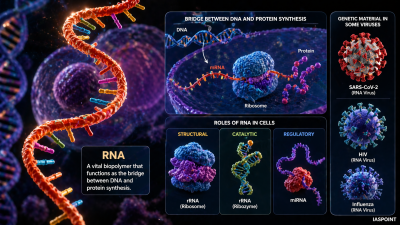
RNA is a vital biopolymer found in all living cells, serving as the primary bridge between the genetic information stored in DNA and the synthesis of proteins. While it functions as the genetic material in certain viruses (e.g., SARS-CoV-2, HIV, Influenza), in most organisms, its role is structural, catalytic, and regulatory.
Chemical Composition and Structure
Like DNA, RNA is a polynucleotide, but it possesses distinct chemical and structural differences:
- Pentose Sugar: Contains Ribose sugar, which has a hydroxyl group (-OH) at the 2′ carbon position. This makes RNA more chemically reactive and less stable than DNA.
- Nitrogenous Bases: Includes Adenine (A), Guanine (G), and Cytosine (C). Notably, RNA contains Uracil (U) instead of Thymine.
- Single-Stranded Nature: RNA is typically single-stranded, though it can fold back on itself to form complex secondary structures like hairpins and loops through internal base pairing (A-U and G-C).
Major Types of RNA and Their Functions
In a eukaryotic cell, three primary types of RNA work together to execute the “Central Dogma” of molecular biology.
1. Messenger RNA (mRNA)
- Function: Acts as a template that carries the genetic code from the DNA in the nucleus to the ribosomes in the cytoplasm.
- Structure: It is linear and contains “codons” (triplets of bases) that specify the amino acid sequence for protein synthesis.
2. Transfer RNA (tRNA)
- Function: Known as the “adapter molecule,” it reads the code on mRNA and brings the corresponding amino acids to the ribosome.
- Structure: It has a characteristic Clover-leaf secondary structure and a compact L-shaped tertiary structure. It contains an “anticodon” loop and an amino acid acceptor end.
3. Ribosomal RNA (rRNA)
- Function: The structural and catalytic component of ribosomes. It ensures the proper alignment of mRNA and tRNA and catalyzes the formation of peptide bonds.
- Prevalence: It is the most abundant type of RNA in the cell (approx. 80%).
Other Biologically Significant RNAs
Beyond the three main types, several other RNA molecules regulate gene expression and cellular defense:
- Small Nuclear RNA (snRNA): Involved in “splicing” (removing non-coding introns from pre-mRNA).
- MicroRNA (miRNA) & Small Interfering RNA (siRNA): Involved in RNA Interference (RNAi), a process that silences specific genes. This is a significant area for modern biotechnology and medical therapy.
- Ribozymes: RNA molecules with enzymatic activity. For example, the peptidyl transferase in ribosomes is a ribozyme.
Comparative Analysis: RNA vs. DNA
| Feature | RNA | DNA |
| Sugar | Ribose | 2-Deoxyribose |
| Base | Uracil (U) | Thymine (T) |
| Strands | Usually single-stranded | Double-stranded helix |
| Stability | Labile (easily degraded by alkalis) | Highly stable |
| Location | Nucleus and Cytoplasm | Primarily in the Nucleus |
| Life Span | Short-lived | Permanent |
The “RNA World” Hypothesis
This hypothesis suggests that RNA was the first self-replicating molecule and the precursor to all current life. It posits that early life forms relied solely on RNA to store genetic information and catalyze chemical reactions (functioning as both DNA and enzymes) before DNA and proteins evolved to take over these specialized roles.
UPSC Prelims Fact File
- RNAi (RNA Interference): A biological process in which RNA molecules inhibit gene expression. In 2006, the Nobel Prize was awarded for its discovery. It is used in developing pest-resistant crops (e.g., against Nematodes).
- Transcription: The process of copying a segment of DNA into RNA by the enzyme RNA Polymerase.
- Retroviruses: These viruses use an enzyme called Reverse Transcriptase to convert their RNA genome into DNA once they infect a host cell.
- Splicing: A post-transcriptional process where non-coding regions (introns) are removed and coding regions (exons) are joined to form a functional mRNA.
- Stability: The 2′-OH group on ribose makes RNA susceptible to hydrolysis, which is why DNA is the preferred molecule for long-term genetic storage.