

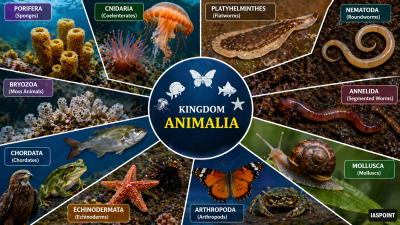
The Kingdom Animalia is classified into several phyla based on structural and functional complexities.
Phylum Porifera (Sponges)
- Level of Organization: Cellular level.
- Habitat: Mostly marine, generally asymmetrical.
- Water Canal System: Water enters through minute pores called Ostia into a central cavity (Spongocoel) and exits through the Osculum. This system aids in food gathering, respiratory exchange, and waste removal.
- Specialized Cells: Choanocytes (collar cells) line the spongocoel and canals.
- Skeleton: Made of spicules or spongin fibers.
- Example: Sycon, Euspongia (Bath sponge), Spongilla (Freshwater sponge).
Phylum Coelenterata (Cnidaria)
- Level of Organization: Tissue level; Diploblastic; Radial symmetry.
- Cnidoblasts: Specialized stinging cells (nematocytes) present on tentacles used for anchorage, defense, and prey capture.
- Digestion: Extra-cellular and intra-cellular; central gastro-vascular cavity with a single opening (hypostome).
- Body Forms: Two basic forms—Polyp (sessile and cylindrical like Hydra) and Medusa (umbrella-shaped and free-swimming like Jellyfish).
- Example: Physalia (Portuguese man-of-war), Adamsia (Sea anemone), Meandrina (Brain coral).
Phylum Ctenophora (Sea Walnuts/Comb Jellies)
- Habitat: Exclusively marine; Radial symmetry; Diploblastic.
- Comb Plates: Possess eight external rows of ciliated comb plates which help in locomotion.
- Bioluminescence: The property of a living organism to emit light is well-marked in ctenophores.
- Example: Pleurobrachia and Ctenoplana.
Phylum Platyhelminthes (Flatworms)
- Body Plan: Dorso-ventrally flattened body; Bilateral symmetry; Triploblastic; Acoelomate.
- Parasitic Adaptations: Hooks and suckers are present in parasitic forms. Some absorb nutrients directly through their body surface.
- Excretion: Specialized cells called Flame cells help in osmoregulation and excretion.
- Example: Taenia (Tapeworm), Fasciola (Liver fluke), Planaria (shows high regeneration capacity).
Phylum Aschelminthes (Roundworms)
- Body Plan: Circular in cross-section; Bilateral symmetry; Triploblastic; Pseudocoelomate.
- Alimentary Canal: Complete with a well-developed muscular pharynx.
- Sexual Dimorphism: Often females are longer than males.
- Example: Ascaris (Roundworm), Wuchereria (Filaria worm), Ancylostoma (Hookworm).
Phylum Annelida (Segmented Worms)
- Segmentation: Body surface is distinctly marked out into segments or metameres (Metamerism).
- Locomotion: Longitudinal and circular muscles; Nereis (aquatic) possesses lateral appendages called parapodia for swimming.
- Circulatory System: Closed circulatory system is present.
- Excretion: Nephridia help in osmoregulation and excretion.
- Example: Pheretima (Earthworm), Hirudinaria (Blood-sucking leech), Nereis.
Phylum Arthropoda (Largest Phylum)
- Diversity: Includes over two-thirds of all named species on earth.
- Exoskeleton: Body is covered by a chitinous exoskeleton.
- Body Divisions: Head, thorax, and abdomen.
- Appendages: Jointed appendages (Arthropoda = jointed feet).
- Respiration: Gills, book gills, book lungs, or tracheal system.
- Excretion: Malpighian tubules.
- Example: Apis (Honey bee), Anopheles (Mosquito), Limulus (King crab – a living fossil).
Phylum Mollusca (Second Largest Phylum)
- Body Plan: Bilateral symmetry; Triploblastic; Coelomate.
- Morphology: Body is covered by a calcareous shell and is unsegmented with a distinct head, muscular foot, and visceral hump.
- Mantle: A soft and spongy layer of skin forms a mantle over the visceral hump. The space between the hump and mantle is the mantle cavity, containing feather-like gills.
- Feeding Organ: File-like rasping organ called Radula.
- Example: Pila (Apple snail), Octopus (Devil fish), Sepia (Cuttlefish).
Phylum Echinodermata (Spiny Bodied)
- Symmetry: Adult echinoderms are radially symmetrical, but larvae are bilaterally symmetrical.
- Water Vascular System: Most distinctive feature; aids in locomotion, capture and transport of food, and respiration.
- Excretory System: Distinct excretory system is absent.
- Example: Asterias (Starfish), Echinus (Sea urchin), Antedon (Sea lily).
Phylum Hemichordata
- Structure: Worm-like marine animals with organ-system level organization.
- Body Divisions: Cylindrical body composed of an anterior proboscis, a collar, and a long trunk.
- Circulatory System: Open type; Respiration via gills.
- Example: Balanoglossus and Saccoglossus.
Phylum Chordata
- Essential Features: Presence of a Notochord, a dorsal hollow nerve cord, and paired pharyngeal gill slits.
- Circulatory System: Closed; Heart is ventral.
- Post-anal tail: Present in most forms.
Comparative Table: Diagnostic Organs of Excretion and Respiration
| Phylum | Excretory Organ | Respiratory Organ |
| Porifera | Diffusion (Cell surface) | Diffusion (Cell surface) |
| Platyhelminthes | Flame Cells | Body surface |
| Annelida | Nephridia | Moist skin/Cuticle |
| Arthropoda | Malpighian Tubules | Gills/Trachea/Book Lungs |
| Mollusca | Organ of Bojanus/Gills | Gills (Ctenidia) |
| Echinodermata | Absent | Water Vascular System |
Trivia for UPSC Prelims
- Living Fossil: Limulus (King Crab) has remained unchanged for millions of years.
- Regeneration King: Planaria possesses an incredible capacity to regenerate a whole body from a small fragment.
- The “Devil Fish”: Octopus belongs to Mollusca, despite lacking a typical external shell.
- Pearl Formation: Occurs in Pinctada (Pearl oyster), which is a Mollusc.