

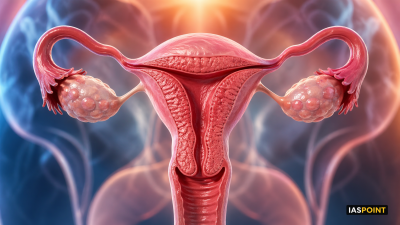
Ovaries are the primary female sex organs (gonads) located in the pelvic cavity, one on each side of the uterus. They are multifunctional organs responsible for both exocrine (production of ova) and endocrine (secretion of hormones) activities.
- Physical Characteristics: Each ovary is approximately 2–4 cm in length and is connected to the pelvic wall and uterus by ligaments (mesovarium).
- Histology: The ovary is covered by a thin germinal epithelium. Beneath this is the ovarian stroma, which is divided into an outer cortex (containing follicles) and an inner medulla (containing blood vessels and nerves).
The Ovum (Female Gamete)
The ovum is the mature female reproductive cell. Unlike sperm, it is one of the largest cells in the human body and is non-motile.
- Structure:
- Nucleus: Contains the haploid set of chromosomes (23, X).
- Cytoplasm (Vitellus): Rich in nutrients for the early embryo.
- Zona Pellucida: A transparent, non-cellular glyco-protein membrane surrounding the plasma membrane.
- Corona Radiata: An outer layer of follicular cells that provide protection and protein to the cell.
- Fact: The human ovum is alecithal, meaning it contains negligible yolk, as the developing embryo receives nutrition via the placenta.
Oogenesis: The Formation of Ova
Oogenesis is a discontinuous process that begins before birth, pauses for years, and finishes only if fertilization occurs.
| Stage | Timing | Description |
| Multiplication | Fetal Life | Oogonia (stem cells) divide mitotically to form millions of cells. |
| Growth | Fetal to Puberty | Oogonia enter Meiosis I and stop at Prophase I, becoming Primary Oocytes. |
| Maturation | Puberty onwards | Monthly, one primary oocyte completes Meiosis I to form a Secondary Oocyte and a tiny First Polar Body. |
| Completion | At Fertilization | Meiosis II is completed only when a sperm penetrates the secondary oocyte, forming the Ootid (ovum) and a Second Polar Body. |
Ovarian Follicles and Maturation
The development of the ovum happens inside specialized structures called follicles.
- Primary Follicle: A primary oocyte surrounded by a single layer of granulosa cells.
- Secondary Follicle: Characterized by more layers of granulosa cells and a new theca layer.
- Tertiary Follicle: Identified by a fluid-filled cavity called the antrum.
- Graafian Follicle: The mature follicle that is ready to rupture.
The Process of Ovulation
Ovulation is the release of the secondary oocyte from the mature Graafian follicle of the ovary.
- Timing: Occurs typically on Day 14 of a 28-day menstrual cycle.
- Hormonal Trigger: Triggered by a sharp surge in Luteinizing Hormone (LH), known as the LH Surge.
- Mechanism: The Graafian follicle ruptures, and the secondary oocyte is released into the peritoneal cavity, where it is captured by the fimbriae of the Fallopian tube.
- Post-Ovulation: After the oocyte is released, the ruptured follicle transforms into a yellow glandular body called the Corpus Luteum, which secretes progesterone.
Hormonal Control of Ovarian Functions
The ovaries are regulated by the pituitary gland through a feedback mechanism.
- Estrogen: Produced by developing follicles; responsible for secondary sexual characteristics and thickening the endometrium.
- Progesterone: Produced by the Corpus Luteum; often called the “pregnancy hormone” as it maintains the uterine lining.
- Inhibin: Secreted by granulosa cells to inhibit FSH secretion, ensuring only one follicle matures per cycle.
UPSC Prelims Fact Sheet: Ovaries & Ovulation
- Atresia: The process where the majority of primary follicles degenerate from birth to puberty. Only about 60,000–80,000 remain at puberty.
- Secondary Oocyte: Strictly speaking, what is released during “ovulation” is not a fully mature “ovum” but a secondary oocyte arrested in Metaphase II.
- Ectopic Pregnancy: Occurs if a fertilized egg implants outside the uterus, often in the Fallopian tube, after failing to be transported correctly post-ovulation.
- Mittelschmerz: A German term for “middle pain,” referring to the one-sided lower abdominal pain some women feel during ovulation.
- Corpus Albicans: If fertilization does not occur, the Corpus Luteum degenerates into a white fibrous tissue called the Corpus Albicans.