

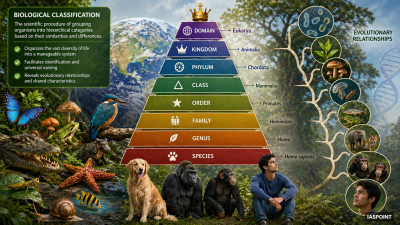
Biological classification is the scientific procedure of grouping organisms into hierarchical categories based on their similarities and differences. It serves as a tool to organize the vast diversity of life into a manageable system, allowing for the study of evolutionary relationships and shared characteristics.
Historical Evolution of Classification Systems
The methods of classification have evolved from simple morphological observations to complex genetic analyses.
| System of Classification | Proposed By | Basis of Classification |
| Two-Kingdom System | Carolus Linnaeus | Divided organisms into Kingdom Plantae and Kingdom Animalia. It failed to distinguish between eukaryotes/prokaryotes and unicellular/multicellular organisms. |
| Three-Kingdom System | Ernst Haeckel | Introduced Kingdom Protista to include unicellular microorganisms. |
| Four-Kingdom System | Herbert Copeland | Introduced Kingdom Monera for prokaryotic organisms. |
| Five-Kingdom System | R.H. Whittaker (1969) | Based on cell structure, body organization, mode of nutrition, reproduction, and phylogenetic relationships. |
| Six-Kingdom System | Carl Woese (1990) | Divided Monera into Archaebacteria and Eubacteria based on 16S ribosomal RNA sequences. |
Whittaker’s Five-Kingdom Classification
This is the standard classification system utilized in biological sciences and competitive examinations. It categorizes life into five distinct kingdoms: Monera, Protista, Fungi, Plantae, and Animalia.
1. Kingdom Monera
- Characteristics: Comprises all prokaryotic organisms. They lack a nuclear membrane and membrane-bound organelles.
- Groups: Includes Bacteria, Cyanobacteria (Blue-green algae), and Mycoplasma (the smallest living cells).
- Nutrition: Can be autotrophic (chemosynthetic or photosynthetic) or heterotrophic (saprophytic or parasitic).
2. Kingdom Protista
- Characteristics: Includes all unicellular eukaryotic organisms. The cell contains a well-defined nucleus and membrane-bound organelles.
- Groups: Includes Chrysophytes (diatoms), Dinoflagellates, Euglenoids, Slime moulds, and Protozoans (Amoeba, Paramecium).
- Significance: This kingdom forms a link between Monera and the multicellular kingdoms (Fungi, Plantae, and Animalia).
3. Kingdom Fungi
- Characteristics: Achromatic (non-photosynthetic), multicellular (except yeast), heterotrophic eukaryotes. Their cell walls are composed of chitin.
- Groups: Includes Phycomycetes, Ascomycetes, Basidiomycetes, and Deuteromycetes.
- Ecology: Primarily decomposers and saprophytes; some form symbiotic associations (e.g., Lichens with algae, Mycorrhiza with plant roots).
4. Kingdom Plantae
- Characteristics: Multicellular eukaryotes containing chlorophyll. They possess a cellulose-based cell wall and follow an autotrophic mode of nutrition.
- Sub-groups: Thallophyta (Algae), Bryophyta, Pteridophyta, Gymnosperms, and Angiosperms.
5. Kingdom Animalia
- Characteristics: Multicellular heterotrophic eukaryotes. Cells lack cell walls. Most exhibit a definite growth pattern and possess a nervous system for coordination.
- Nutrition: Holozoic (ingestion of food).
The Three Domains of Life
Modern systematics often uses the “Domain” system, which is a taxonomic rank higher than Kingdom.
- Domain Archaea: Includes prokaryotes with distinct 16S rRNA and cell membrane lipids that allow them to survive in extreme environments (extremophiles).
- Domain Bacteria: Includes true bacteria (Eubacteria) like E. coli and Cyanobacteria.
- Domain Eukarya: Encompasses all eukaryotic organisms across four kingdoms: Protista, Fungi, Plantae, and Animalia.
Key Criteria for Modern Classification
To ensure a 360° understanding for UPSC Prelims, the following criteria used by modern taxonomists must be noted:
- Cell Structure: Distinction between Prokaryotic (no nucleus) and Eukaryotic (nucleus present) cells.
- Body Organization: Whether the organism is unicellular (single-celled) or multicellular (tissue/organ/system level).
- Mode of Nutrition: Autotrophic (producers), Heterotrophic (consumers), or Saprotrophic (decomposers).
- Phylogenetic Relationships: The evolutionary history and ancestry of the organism.
UPSC Prelims Trivia: Non-Classified Entities
Certain biological entities do not find a place in Whittaker’s Five-Kingdom system because they are not considered “truly living” or are acellular:
- Viruses: Contain DNA or RNA but lack a cellular machinery; they are obligate parasites.
- Viroids: Smaller than viruses; infectious RNA particles without a protein coat (discovered by T.O. Diener).
- Prions: Infectious proteins that cause neurological diseases (e.g., Mad Cow Disease).
- Lichens: Symbiotic associations between Algae (Phycobiont) and Fungi (Mycobiont). They are highly sensitive to air pollution (SO2 indicators).