

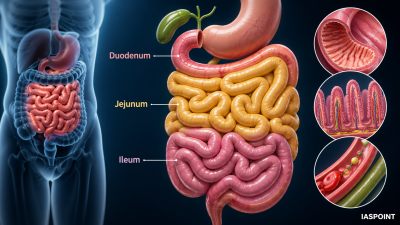
The small intestine is the longest part of the alimentary canal, measuring approximately 6 to 7 meters in a living adult. It is the primary site for the complete digestion of carbohydrates, proteins, and fats, and the nearly exclusive site for the absorption of nutrients into the bloodstream. It is divided into three distinct anatomical regions: the Duodenum, Jejunum, and Ileum.
Anatomical Divisions
1. Duodenum
- Shape: C-shaped (or U-shaped) and the shortest segment (approx. 25 cm).
- Function: It receives the Hepatopancreatic duct, which brings bile from the liver/gallbladder and pancreatic juice from the pancreas.
- Special Feature: Contains Brunner’s Glands in the sub-mucosa, which secrete alkaline mucus to neutralize acidic chyme coming from the stomach.
2. Jejunum
- Structure: The middle portion, characterized by a long, coiled tube.
- Function: Primarily responsible for the bulk of chemical digestion and nutrient absorption. It has a thick muscular wall and a rich blood supply.
3. Ileum
- Structure: The longest and highly coiled posterior part (approx. 3.5 meters).
- Function: Absorbs Vitamin B12, bile salts, and any remaining nutrients. It opens into the large intestine via the Ileocaecal valve.
- Special Feature: Contains Peyer’s Patches, which are lymphoid tissue clusters that provide local immunity against pathogens.
Histology: Modifications for Absorption
The small intestine is uniquely adapted to maximize surface area for absorption through three levels of folding:
- Plicae Circulares: Circular permanent folds of the mucosa and sub-mucosa.
- Villi: Finger-like projections of the mucosal layer. Each villus is supplied with a network of blood capillaries and a large central lymph vessel called a Lacteal (specifically for fat absorption).
- Microvilli: Microscopic hair-like projections on the surface of individual epithelial cells (Enterocytes), creating a “Brush Border” appearance.
Chemical Digestion: The Intestinal Juice
The mucosal epithelium contains goblet cells which secrete mucus. The secretions of the brush border cells of the mucosa, along with the secretions of the goblet cells, constitute the Succus Entericus (Intestinal Juice).
| Enzyme | Substrate | Final Product |
| Disaccharidases (e.g., Maltase) | Maltose | Glucose + Glucose |
| Dipeptidases | Dipeptides | Amino Acids |
| Lipases | Diglycerides/Monoglycerides | Fatty acids + Glycerol |
| Nucleosidases | Nucleosides | Sugars + Bases |
| Enterokinase | Trypsinogen (Pancreatic) | Active Trypsin |
Mechanism of Nutrient Absorption
| Nutrient Type | Mode of Absorption | Pathway |
| Glucose & Amino Acids | Active transport or Facilitated diffusion | Blood Capillaries → Hepatic Portal Vein |
| Fructose | Facilitated diffusion | Blood Capillaries |
| Fatty Acids & Glycerol | Insoluble; converted into Chylomicrons | Lacteals (Lymphatic system) |
| Water | Osmosis | Blood Capillaries |
UPSC Prelims Fact File
- Hepatopancreatic Duct: This duct is guarded by the Sphincter of Oddi, which controls the flow of digestive juices into the duodenum.
- Crypts of Lieberkuhn: Tubular glands found between the bases of villi in the intestinal wall; they secrete the enzymes of the Succus Entericus.
- Surface Area: Due to villi and microvilli, the internal surface area of the small intestine is increased by nearly 600 times, roughly equivalent to the size of a tennis court.
- pH Level: The environment in the small intestine is alkaline (pH 7.8 to 8.5), which is essential for the activation of pancreatic enzymes.
- Vestigial Connection: The ileum contains the Meckel’s Diverticulum in about 2% of the population, a remnant of the yolk duct from embryonic development.
Functional Summary
- Digestion: Final breakdown of macromolecules into monomers.
- Absorption: Transfer of monomers from the intestinal lumen to the blood or lymph.
- Hormonal Control: Secretes hormones like Secretin and Cholecystokinin (CCK) to regulate liver and pancreatic activity.