

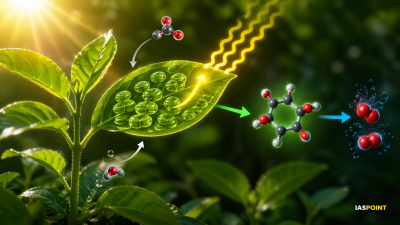
Photosynthesis is a physico-chemical process by which green plants, algae, and certain bacteria convert light energy into chemical energy.
Site of Photosynthesis: The Chloroplast
Photosynthesis occurs primarily in the leaves, specifically within the mesophyll cells which contain high concentrations of chloroplasts.
- Chloroplast Structure: These are double-membrane organelles. The interior contains a fluid called stroma and a system of membranous sacs called thylakoids.
- Grana: Stacks of thylakoids where the “Light-dependent reactions” occur.
- Stroma: The site for “Light-independent reactions” (Dark reactions/Calvin Cycle) where enzymatic synthesis of sugar takes place.
- Pigments involved:
- Chlorophyll a: The primary pigment (bright or blue-green in chromatogram).
- Chlorophyll b: Accessory pigment (yellow-green).
- Xanthophylls: Accessory pigment (yellow).
- Carotenoids: Accessory pigment (yellow to yellow-orange).
The Two-Phase Mechanism
The process is divided into two distinct but interrelated phases: the Light Reaction and the Dark Reaction.
Light-Dependent Reaction (Photochemical Phase)
This phase takes place in the grana and requires direct sunlight. It involves light absorption, water splitting, oxygen release, and the formation of high-energy chemical intermediates.
- Photolysis of Water: Light energy splits water molecules into protons (H^+), electrons (e^-), and oxygen (O2).
- Photophosphorylation: The process of creating ATP from ADP using light energy. It can be Cyclic (involving only Photosystem I) or Non-cyclic (involving both PS I and PS II).
- Key Products: ATP, NADPH, and O2 (released as a byproduct).
Light-Independent Reaction (Biosynthetic Phase)
Also known as the Calvin Cycle, this occurs in the stroma. It does not directly require light but depends on the products of the light reaction (ATP and NADPH).
- Carboxylation: Fixation of CO2 into a stable organic intermediate.
- Reduction: Series of reactions leading to the formation of glucose.
- Regeneration: Regeneration of the CO2 acceptor molecule (RuBP) to continue the cycle.
Comparison of C3 and C4 Pathways
Plants have evolved different mechanisms for carbon fixation based on their environmental adaptations.
| Feature | C3 Plants | C4 Plants |
| Primary CO2 Acceptor | RuBP (5-carbon) | PEP (3-carbon) |
| First Stable Product | 3-PGA (3-carbon) | OAA (4-carbon) |
| Kranz Anatomy | Absent | Present (Specialized bundle sheath cells) |
| Photorespiration | High (leads to energy loss) | Negligible or Absent |
| Optimum Temperature | 20–25°C | 30–45°C |
| Examples | Rice, Wheat, Soybeans | Maize, Sugarcane, Sorghum |
Photorespiration: The “Wasteful” Process
Photorespiration occurs when the enzyme RuBisCO (the most abundant protein on Earth) binds with Oxygen (O2) instead of Carbon Dioxide (CO2). This typically happens under high light intensity and high temperatures.
- Result: It does not produce ATP or sugar; instead, it releases CO2 and consumes ATP.
- Adaptation: C4 plants have evolved to bypass this process by increasing the concentration of CO2 at the enzyme site, ensuring higher productivity.
Factors Affecting Photosynthesis (Blackman’s Law of Limiting Factors)
The rate of photosynthesis is governed by the factor that is at its sub-optimal level.
- Light: Intensity, quality (blue and red regions are most effective), and duration affect the rate. There is a linear relationship between incident light and CO2 fixation at low intensities.
- Carbon Dioxide Concentration: The major limiting factor in nature. C4 plants reach saturation at lower CO2 levels than C3 plants.
- Temperature: Dark reactions, being enzymatic, are temperature-controlled. C4 plants respond to higher temperatures compared to C3 plants.
- Water: Water stress causes stomata to close, reducing CO2 availability, and wilts leaves, reducing surface area.
Critical Trivia for UPSC Prelims
- Crassulacean Acid Metabolism (CAM): Found in succulents (e.g., Cacti, Pineapple). Stomata open at night to fix CO2 to minimize water loss.
- Absorption Spectrum vs. Action Spectrum: Chlorophyll a absorbs mostly in blue and red regions; the action spectrum shows that the maximum rate of photosynthesis also occurs in these regions.
- RuBisCO Dual Nature: It can act as both a Carboxylase and an Oxygenase depending on the relative concentration of O2 and CO2.
- Compensation Point: The light intensity at which the rate of photosynthesis exactly matches the rate of respiration, resulting in zero net gas exchange.