

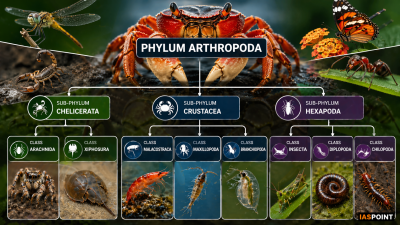
Phylum Arthropoda is classified into several sub-phyla and classes based on body division, the number of appendages, and respiratory organs.
1. Sub-phylum: Chelicerata
These arthropods lack antennae and typically have the body divided into a cephalothorax and abdomen. The first pair of appendages are “chelicerae” used for feeding.
Class Arachnida
- Appendages: Four pairs of walking legs (8 legs total).
- Respiration: Use book lungs or tracheae.
- Excretion: Via Malpighian tubules or coxal glands.
- Sensory: Lack antennae and compound eyes; usually possess simple eyes.
- Examples: Spiders, Scorpions, Ticks, and Mites.
Class Merostomata
- Environment: Exclusively marine.
- Respiration: Through book gills.
- Notable Fact: Includes the King Crab (Limulus), famously known as a “living fossil” because it has remained unchanged for over 450 million years.
2. Sub-phylum: Crustacea
This group is predominantly aquatic (marine and freshwater) and is distinguished by having two pairs of antennae.
General Features
- Body Division: Usually a cephalothorax covered by a dorsal shield called a carapace.
- Respiration: Generally through gills.
- Excretion: Specialized Green Glands (Antennal Glands).
- Appendages: Biramous (forked) appendages.
- Examples: Prawns (Palaemon), Crabs, Lobsters, and Daphnia (Water flea).
3. Sub-phylum: Hexapoda
This is the largest group, dominated by the Class Insecta. These organisms are primarily terrestrial.
Class Insecta
- Body Division: Distinct Head, Thorax, and Abdomen.
- Thoracic Appendages: Three pairs of jointed legs (hence the name “Hexapoda”) and usually two pairs of wings.
- Respiration: A complex Tracheal System opening through spiracles.
- Excretion: Malpighian tubules.
- Sensory: One pair of antennae and compound eyes.
- Examples: Ants, Bees, Cockroaches, Butterflies, and Mosquitoes.
4. Sub-phylum: Myriapoda
Characterized by elongated bodies with numerous segments, each bearing legs. They are terrestrial and prefer moist environments.
Class Chilopoda (Centipedes)
- Legs: One pair of legs per body segment.
- Nature: Predatory and venomous; the first pair of legs is modified into poison claws.
- Example: Scolopendra.
Class Diplopoda (Millipedes)
- Legs: Two pairs of legs per body segment (except the first few).
- Nature: Generally herbivorous or detritivorous; non-venomous but may secrete foul-smelling fluids for defense.
- Example: Julus.
Comparative Analysis of Major Groups
| Feature | Arachnids | Crustaceans | Insects | Myriapods |
| Body Divisions | Cephalothorax & Abdomen | Cephalothorax & Abdomen | Head, Thorax, Abdomen | Head & Trunk |
| Pairs of Legs | 4 Pairs | 5+ Pairs (Variable) | 3 Pairs | Many Pairs |
| Antennae | Absent | 2 Pairs | 1 Pair | 1 Pair |
| Eyes | Simple | Compound | Compound | Simple |
| Habitat | Terrestrial | Mostly Aquatic | Mostly Terrestrial | Terrestrial |
Specialized Trivia for UPSC Prelims
- Social Insects: Termites and Honey bees exhibit advanced social hierarchies and “division of labor,” a frequent topic in ecological niche questions.
- Pheromones: Many arthropods, especially insects (ants/silkworms), use chemical signals called pheromones for communication and trail-following.
- Parthenogenesis: Some arthropods like honey bees and aphids can reproduce via unfertilized eggs, a process known as parthenogenesis.
- Malpighian Tubules Position: These are located at the junction of the midgut and hindgut, facilitating the removal of uric acid in terrestrial insects to conserve water.