

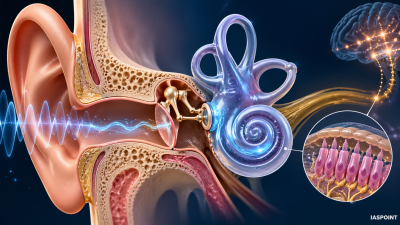
The hearing mechanism is a sophisticated process that involves the conversion of mechanical sound waves in the air into fluid waves in the inner ear, which are then translated into electrical impulses. This process occurs through a series of steps involving the outer, middle, and inner ear.
1. Collection and Transmission of Sound
- Sound Capture: The Pinna collects sound waves from the environment and directs them into the External Auditory Canal.
- Vibration of Tympanum: These waves strike the Tympanic Membrane (Eardrum), causing it to vibrate. The frequency of vibration corresponds to the pitch of the sound.
2. Amplification in the Middle Ear
- Chain Reaction: The vibrations are transmitted to the three ear ossicles—Malleus, Incus, and Stapes.
- Amplification: Because the surface area of the eardrum is much larger than that of the Oval Window (the entry to the inner ear), the ossicles act as a lever system, amplifying the sound pressure by approximately 20 times to move the denser fluid of the inner ear.
3. Transduction in the Cochlea
The inner ear is where the actual sensory transduction occurs within the fluid-filled Cochlea.
- Fluid Movement: The Stapes pushes against the Oval Window, creating pressure waves in the Perilymph of the scala vestibuli.
- Basilar Membrane Response: These waves reach the Scala Media and cause the Basilar Membrane to ripple or vibrate.
- Stimulation of Hair Cells: Located on the Basilar Membrane is the Organ of Corti, which contains sensory hair cells. As the membrane moves, the “hairs” (stereocilia) press against the rigid Tectorial Membrane above them.
- Signal Generation: The bending of these hair cells opens ion channels, generating an action potential (nerve impulse).
4. Neural Interpretation
- Auditory Nerve: The nerve impulses are carried by the Cochlear Nerve (a branch of the VIII cranial nerve).
- Brain Processing: The impulses reach the Auditory Cortex in the temporal lobe of the brain, where the signals are analyzed and perceived as specific sounds.
| Step | Location | Energy Form |
| Capture | Outer Ear | Acoustic (Sound Waves) |
| Amplification | Middle Ear | Mechanical (Vibration) |
| Transduction | Inner Ear (Cochlea) | Hydraulic (Fluid Waves) |
| Transmission | Auditory Nerve | Electrical (Nerve Impulse) |
Key Factors Affecting Hearing
- Pitch (Frequency): High-frequency sounds stimulate hair cells at the base of the cochlea, while low-frequency sounds stimulate those at the apex (tip).
- Loudness (Amplitude): Louder sounds cause more vigorous vibrations of the basilar membrane and a higher frequency of nerve impulses.
Trivia and UPSC Prelims Facts
- Smallest Muscle: The Stapedius muscle in the middle ear attaches to the stapes. It contracts to dampen loud noises, protecting the inner ear from damage (Acoustic Reflex).
- Deafness Types:
- Conduction Deafness: Caused by interference in the transmission of sound (e.g., earwax buildup, ruptured eardrum, or ossicle stiffness).
- Sensory Deafness: Caused by damage to the hair cells in the cochlea or the auditory nerve (often due to aging or loud noise exposure).
- Echo: For an echo to be heard clearly by the human ear, the reflecting surface must be at a minimum distance of approximately 17.2 meters, accounting for the persistence of hearing (0.1 seconds).