

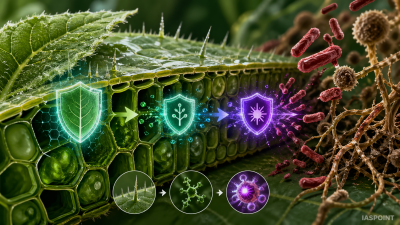
Unlike animals, plants lack an adaptive immune system with mobile defender cells (like white blood cells). Instead, they rely on a two-tiered innate immune system and structural barriers.
Structural and Chemical Barriers (Passive Immunity)
Before a pathogen can infect a plant, it must bypass physical and chemical deterrents. These are often pre-existing (constitutive) features.
- Waxy Cuticle and Thorns: The outermost layer prevents water film formation, which is necessary for fungal spore germination.
- Stomatal Closure: Plants can actively close stomata (pores) upon sensing a pathogen to prevent entry.
- Secondary Metabolites: Plants produce antimicrobial chemicals such as Phytoanticipins (e.g., saponins, tannins, and alkaloids) that inhibit the growth of bacteria and fungi.
The Two-Tiered Innate Immune System (Active Immunity)
When a pathogen breaches physical barriers, the plant activates a sophisticated molecular defense mechanism.
1. PAMP-Triggered Immunity (PTI)
- Mechanism: Plant cells have Pattern Recognition Receptors (PRRs) on their surface that recognize Pathogen-Associated Molecular Patterns (PAMPs).
- Examples of PAMPs: Chitin (from fungal cell walls) or Flagellin (from bacterial tails).
- Result: This is the first line of defense, leading to cell wall thickening and the production of reactive oxygen species (ROS) to kill the invader.
2. Effector-Triggered Immunity (ETI)
- Mechanism: Specialized pathogens inject “effectors” to suppress PTI. In response, plants evolved R-genes (Resistance genes).
- NB-LRR Proteins: These internal receptors detect specific pathogen effectors.
- Result: This is a more robust, faster response than PTI, often culminating in the Hypersensitive Response (HR).
Specific Defense Responses
Hypersensitive Response (HR)
This is a form of programmed cell death at the site of infection. By deliberately killing infected cells and surrounding healthy cells, the plant “starves” the pathogen and prevents it from spreading to the rest of the plant body.
Systemic Acquired Resistance (SAR)
SAR is a “whole-plant” resistance response that occurs following an earlier localized exposure to a pathogen.
- Chemical Signal: Salicylic Acid is the primary signaling molecule for SAR.
- Effect: It “primes” the rest of the plant, putting it on high alert so it can respond more vigorously to subsequent attacks. It is analogous to the “memory” in animal immune systems but without antibodies.
Genetic and Biotechnological Resistance
The Gene-for-Gene Hypothesis
Proposed by Harold Flor, this theory states that for every resistance gene (R-gene) in the host, there is a corresponding avirulence gene (Avr-gene) in the pathogen. If the pair matches, the plant is resistant; if not, the plant becomes diseased.
RNA Interference (RNAi)
A biological process where RNA molecules inhibit gene expression. In agriculture, scientists develop transgenic plants that produce double-stranded RNA. When a virus or pest attacks, the RNAi mechanism “silences” the essential genes of the pathogen, rendering it harmless.
Table: Comparison of Defense Signaling Molecules
| Molecule | Role in Immunity | Associated Disease/Stress |
| Salicylic Acid (SA) | Triggers Systemic Acquired Resistance (SAR) | Biotrophic pathogens (Fungi/Bacteria) |
| Jasmonic Acid (JA) | Defense against herbivory and necrotrophic pathogens | Insects and tissue-killing fungi |
| Ethylene | Works with JA to regulate defense gene expression | Fruit ripening and stress response |
UPSC Prelims Trivia: Disease Resistance Facts
- Vertical Resistance: Governed by a single or few R-genes; highly effective but easily broken down by new pathogen strains.
- Horizontal Resistance: Controlled by many genes (polygenic); provides partial but more stable and long-lasting protection.
- Phytoalexins: These are antimicrobial substances synthesized de novo (from scratch) by plants only after they have been stressed or attacked by a pathogen.
- Callose Deposition: Plants strengthen their cell walls by depositing callose (a polysaccharide) at the site of fungal penetration to physically block the hyphae.