

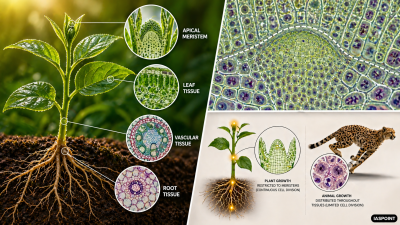
Plant tissues are categorized based on their ability to divide and their developmental stage. Unlike animal tissues, plant growth is largely restricted to specific regions called meristems, which maintain the capacity for continuous cell division throughout the plant’s life.
1. Meristematic Tissues (Growth Tissues)
Meristematic tissues consist of actively dividing cells that lead to the formation of new organs and structural growth. These cells are characterized by thin cellulose walls, dense cytoplasm, prominent nuclei, and a lack of vacuoles.
- Apical Meristem: Located at the growing tips of stems and roots. It is responsible for the increase in the length of the plant (Primary Growth).
- Lateral Meristem (Cambium): Located on the lateral sides of stems and roots. It is responsible for increasing the girth or thickness of the plant (Secondary Growth).
- Intercalary Meristem: Located at the base of leaves or internodes (common in grasses). It facilitates the elongation of internodes and regrowth in herbivorous plants.
2. Permanent Tissues
Permanent tissues are derived from meristematic tissues that have lost their ability to divide and have attained a definite shape, size, and function through the process of differentiation.
A. Simple Permanent Tissues
These are composed of a single type of cell that is structurally and functionally similar.
| Tissue Type | Characteristic Features | Primary Function |
| Parenchyma | Thin-walled, living cells with large intercellular spaces. | Food storage, photosynthesis (Chlorenchyma), and buoyancy (Aerenchyma in aquatic plants). |
| Collenchyma | Living cells with localized thickening (pectin) at corners; little intercellular space. | Provides mechanical support and flexibility to young stems and leaf stalks (petioles). |
| Sclerenchyma | Dead cells with highly thickened lignified walls; no intercellular spaces. | Provides extreme rigidity and strength (e.g., grit in pears, coconut husk, hemp fibers). |
B. Complex Permanent Tissues
These are composed of more than one type of cell working together as a unit to perform a common function, primarily transport.
- Xylem (Water Conducting Tissue): Consists of four elements:
- Tracheids: Elongated dead cells with tapering ends.
- Vessels: Tube-like dead structures for vertical conduction.
- Xylem Parenchyma: The only living component; used for food storage.
- Xylem Fibres: Dead cells providing mechanical support.
- Phloem (Food Conducting Tissue): Consists of four elements:
- Sieve Tubes: Tubular cells with perforated walls (Sieve plates); lack a nucleus at maturity.
- Companion Cells: Living cells that regulate the activity of sieve tubes.
- Phloem Parenchyma: Living cells involved in storage and lateral transport.
- Phloem Fibres (Bast Fibres): The only dead component; provide mechanical strength (e.g., Jute, Flax).
Summary Table: Classification Hierarchy
| Level 1 | Level 2 | Level 3 | Examples/Location |
| Meristematic | Based on Position | Apical, Lateral, Intercalary | Root tips, Cambium, Nodes |
| Permanent | Simple | Parenchyma, Collenchyma, Sclerenchyma | Soft parts, Stems, Nut shells |
| Complex | Xylem, Phloem | Vascular bundles |
UPSC Prelims Facts and Trivia
- Aerenchyma: A specialized form of parenchyma found in hydrophytes (aquatic plants) containing large air cavities that provide buoyancy.
- Lignin: A complex polymer that acts as a cement and hardens the cell wall in sclerenchyma; it is waterproof and provides high compressive strength.
- Differentiation: The process by which cells take up a permanent shape, size, and function is called differentiation.
- Secondary Growth: In dicot plants, the lateral meristem (vascular cambium and cork cambium) allows the plant to grow in diameter, a feature generally absent in monocots.
- Bast Fibres: Phloem fibres are commercially significant. For example, jute and linen are derived from the phloem fibres of their respective plants.