

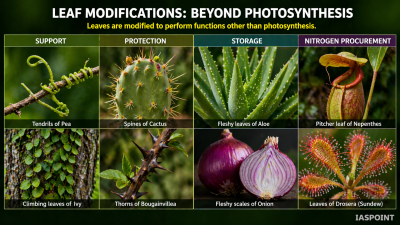
In many plant species, leaves are modified to perform functions other than photosynthesis, such as support, protection, storage, and nitrogen procurement.
Modifications for Support and Climbing
Weak-stemmed plants often modify their leaves into specialized structures to gain height for better sunlight exposure.
- Leaf Tendrils: The entire leaf or a part of it is modified into a slender, thread-like, spirally coiled structure. When it touches a support, it coils around it.
- Entire leaf modified: Lathyrus aphaca (Wild pea).
- Leaflets modified: Pisum sativum (Garden pea).
- Leaf tip modified: Gloriosa superba (Glory lily).
- Leaf Hooks: In some climbers, leaves are modified into hook-like structures to cling to the bark of trees (e.g., Bignonia unguis-cati or Cat’s claw).
Modifications for Protection and Water Conservation
In arid and semi-arid regions (Xerophytes), leaves undergo modifications to reduce the surface area for transpiration and to deter herbivores.
- Leaf Spines: Leaves are reduced to sharp, pointed spines. In such cases, the stem usually becomes green and fleshy (Phylloclade) to perform photosynthesis.
- Examples: Opuntia (Cactus), Aloe, Argemone (Mexican poppy).
- Scale Leaves: Small, dry, stalkless, membrane-like structures that protect axillary buds.
- Examples: Casuarina, Asparagus, and onion bulbs.
Modifications for Food and Water Storage
Certain plants store metabolic reserves or water within their leaf tissues to survive unfavorable conditions.
- Fleshy Leaves: Leaves become thick and succulent due to the storage of water and mucilage.
- Examples: Aloe vera, Bryophyllum, Sedum.
- Storage Leaves in Bulbs: In plants like Onion and Garlic, the underground part consists of highly reduced stems surrounded by fleshy scale leaves that store food.
Modifications for Nitrogen Procurement (Insectivorous Plants)
Plants growing in nitrogen-deficient soils (like marshes) have evolved highly specialized leaf structures to trap and digest insects.
| Modification | Mechanism | Examples |
| Leaf Pitcher | The lamina is modified into a pitcher-like structure with a lid to trap insects. | Nepenthes (Pitcher plant) |
| Leaf Bladder | Segments of the leaf form small bladders with trap doors to catch aquatic micro-organisms. | Utricularia (Bladderwort) |
| Venus Flytrap | The lamina is divided into two hinged halves with sensitive “trigger hairs” and marginal teeth. | Dionaea muscipula |
Specialized Structural Modifications
- Phyllode: The petiole (leaf stalk) or a part of the rachis becomes flattened, green, and leaf-like to perform photosynthesis, while the true lamina is short-lived or absent.
- Example: Australian Acacia. (Note: Do not confuse this with Phylloclade, which is a stem modification).
- Reproductive Leaves: Some leaves develop adventitious buds along their margins which, upon falling on moist soil, develop into new plants.
- Example: Bryophyllum (Sprout leaf plant).
UPSC Prelims Fact Sheet: Leaf Modifications
- Phyllode vs. Phylloclade: UPSC often tests this distinction. A Phyllode is a modified petiole (leaf part), while a Phylloclade is a modified stem. Both are adaptations to reduce transpiration.
- Petiole Modification in Eichhornia: In Water Hyacinth, the petiole becomes swollen and spongy (filled with aerenchyma) to provide buoyancy, allowing the plant to float.
- Spines vs. Thorns: Morphologically, Spines are modified leaves (e.g., Cactus), whereas Thorns are modified stems (e.g., Citrus).
- Pulvinus: In legumes like Mimosa pudica (Touch-me-not), the leaf base is swollen (pulvinus) and is responsible for the rapid “sleep movements” or folding of leaves when touched, due to changes in turgor pressure.