

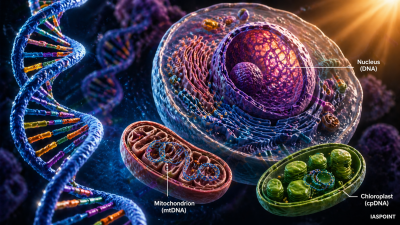
DNA is a long polymer of deoxyribonucleotides and serves as the primary genetic material for the vast majority of living organisms. It stores the hereditary information required for the development, survival, and reproduction of life. In eukaryotes, it is primarily located in the cell nucleus, with smaller amounts found in mitochondria (mtDNA) and chloroplasts (cpDNA).
Chemical Components of DNA
Each nucleotide building block of DNA is composed of three distinct chemical units:
- Pentose Sugar: 2-deoxyribose (a five-carbon sugar lacking an oxygen atom at the 2′ position, which enhances DNA’s chemical stability).
- Phosphoric Acid: Forms the phosphate group (PO43-) that links the sugars.
- Nitrogenous Bases: These are categorized into:
- Purines: Adenine (A) and Guanine (G).
- Pyrimidines: Cytosine (C) and Thymine (T).
The Watson and Crick Double Helix Model
In 1953, James Watson and Francis Crick, utilizing X-ray diffraction data from Rosalind Franklin and Maurice Wilkins, proposed the double helical structure of DNA.
Salient Features of the Double Helix
- Polynucleotide Chains: DNA consists of two strands made of a sugar-phosphate backbone, with the nitrogenous bases projected inward.
- Anti-parallel Polarity: The two strands run in opposite directions; one in the 5′ → 3′ direction and the other in the 3′ → 5′ direction.
- Complementary Base Pairing: Bases are held together by hydrogen bonds. Adenine pairs with Thymine (A=T) via two hydrogen bonds, and Guanine pairs with Cytosine (G≡C) via three hydrogen bonds.
- Dimensions: * The helix has a diameter of approximately 2 nm.
- The pitch (one complete turn) is 3.4 nm.
- There are roughly 10 base pairs in each turn, meaning the distance between adjacent base pairs is 0.34 nm.
Packaging of DNA: From Helix to Chromosome
A human diploid cell contains approximately 6.6 x 10⁹ base pairs. If stretched out, the DNA from a single cell would measure nearly 2.2 meters in length. To fit inside a microscopic nucleus, DNA undergoes sophisticated packaging.
- Nucleosomes: DNA (negatively charged) wraps around a core of positively charged proteins called Histones (rich in basic amino acids like Lysine and Arginine).
- Chromatin: A “beads-on-a-string” structure formed by repeating nucleosomes.
- Chromosomes: During cell division, chromatin further condenses into thick, thread-like structures called chromosomes.
Key Rules and Principles
- Chargaff’s Rule: In any double-stranded DNA molecule, the total amount of Purines equals the total amount of Pyrimidines ([A+G] = [T+C]). Therefore, the ratio of A/T = 1 and G/C = 1.
- Denaturation and Renaturation: High temperatures can break the hydrogen bonds between strands (denaturation). If cooled slowly, the complementary strands can re-pair (renaturation/annealing).
- Central Dogma of Molecular Biology: Proposed by Francis Crick, it defines the flow of genetic information: DNA Transcription→ RNA Translation→ Protein.
Comparison of DNA Forms
| Feature | B-DNA | A-DNA | Z-DNA |
| Helical Sense | Right-handed | Right-handed | Left-handed |
| Occurrence | Most common/Physiological | Dehydrated conditions | High salt concentrations |
| Base Pairs per Turn | 10 | 11 | 12 |
UPSC Prelims Fact File
- Mitochondrial DNA (mtDNA): It is small, circular, and inherited maternally. It is often used in evolutionary studies and forensic “maternal lineage” tracing.
- Non-coding DNA: A large portion of the human genome (nearly 98%) does not code for proteins. These regions include introns and repetitive sequences used in DNA Fingerprinting.
- Chemical Stability: DNA is more stable than RNA because the deoxyribose sugar is less reactive than ribose, and the presence of Thymine instead of Uracil provides additional resistance to oxidative damage.
- Replication: DNA replication is semi-conservative, meaning each new DNA molecule consists of one “old” parent strand and one newly synthesized “daughter” strand.
- Epigenetics: Chemical modifications to DNA (like methylation) that do not change the sequence but regulate gene expression.