

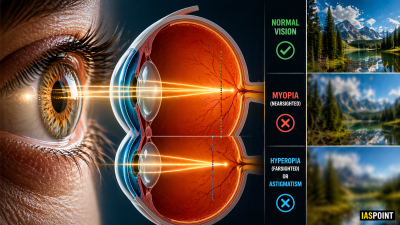
Visual defects occur when the eye’s refractive system fails to focus light precisely on the retina.
1. Myopia (Near-Sightedness)
In a myopic eye, the individual can see nearby objects clearly but distant objects appear blurred.
- Anatomical Cause: The eyeball becomes elongated (too long) or the curvature of the cornea/lens is excessively high.
- Focal Point: Light rays from a distant object converge at a point in front of the retina rather than on it.
- Correction: A Concave Lens (diverging lens) is used. It diverges the incoming light rays so that the lens can focus them further back, exactly on the retina.
2. Hypermetropia (Far-Sightedness)
The individual can see distant objects clearly but faces difficulty in focusing on nearby objects.
- Anatomical Cause: The eyeball becomes too short or the lens has an insufficient curvature (focal length is too long).
- Focal Point: Light rays from a nearby object converge at a point behind the retina.
- Correction: A Convex Lens (converging lens) is used. It provides additional refraction to converge the light rays earlier, ensuring they land on the retina.
3. Presbyopia (Old-Age Far-Sightedness)
This is an age-related condition that usually manifests after the age of 40. It is not necessarily due to eyeball shape but rather the loss of physiological flexibility.
- Cause: Gradual weakening of the Ciliary Muscles and diminishing flexibility of the crystalline lens. The power of accommodation decreases.
- Correction: Use of Bifocal Lenses. The upper portion is usually concave (for distant vision) and the lower portion is convex (for reading/near vision).
4. Astigmatism
This defect results in blurred vision at all distances because light is not focused evenly onto the retina.
- Cause: Irregular or asymmetric curvature of the Cornea or the lens. Instead of being spherical like a basketball, the cornea is shaped more like a football.
- Symptom: Points are perceived as lines; the individual may see horizontal lines clearly but vertical lines blurred, or vice versa.
- Correction: Use of Cylindrical Lenses, which compensate for the specific irregularity in the curvature of the cornea.
Comparative Summary of Eye Defects
| Defect | Image Formation | Cause | Corrective Lens |
| Myopia | In front of Retina | Elongated eyeball | Concave (Diverging) |
| Hypermetropia | Behind Retina | Shortened eyeball | Convex (Converging) |
| Presbyopia | Behind Retina | Loss of lens elasticity | Bifocal |
| Astigmatism | Multiple focal points | Irregular Cornea | Cylindrical |
Additional Clinical Conditions for UPSC
- Cataract: A condition where the crystalline lens becomes opaque or cloudy due to the deposition of proteins. It is treated surgically by replacing the natural lens with an Intraocular Lens (IOL).
- Glaucoma: Caused by excessive Intraocular Pressure due to the buildup of aqueous humor. If untreated, it damages the optic nerve and can lead to permanent blindness.
- Trachoma: An infectious disease caused by Chlamydia trachomatis bacteria; it is a leading cause of preventable blindness worldwide. (India was declared free of infective trachoma by the WHO).
- Amblyopia (Lazy Eye): A condition where the brain ignores input from one eye, usually due to a lack of coordination during early childhood development.
Key Trivia for Prelims
- Dioptre (D): The unit used to measure the power of a lens. P = 1/f (where f is the focal length in meters). Concave lenses have negative power, while convex lenses have positive power.
- Laser-Assisted in Situ Keratomileusis (LASIK): A popular surgical procedure that uses a laser to reshape the cornea to correct myopia, hypermetropia, and astigmatism.
- Vitamin A: Essential for the synthesis of Retinal, a component of light-sensitive pigments. Its deficiency primarily affects rod cells first, causing night blindness.