

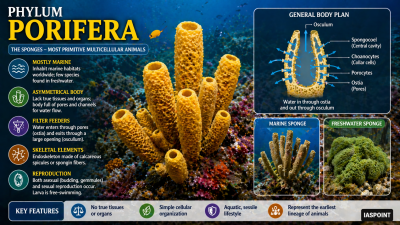
Phylum Porifera, commonly known as sponges, represents the most primitive group of multicellular animals. They are primarily marine organisms, though a few species inhabit freshwater.
Taxonomic Classification and General Characteristics
Porifera belongs to the Kingdom Animalia and is characterized by a “pore-bearing” body.
- Level of Organization: Cellular level of organization. Cells are loose aggregates and do not form true tissues or organs.
- Symmetry: Mostly asymmetrical, though some species exhibit radial symmetry.
- Germ Layers: Diploblastic (derived from two embryonic layers), though the layers are not true tissues.
- Habitat: Primarily marine; Spongilla is a notable freshwater exception.
Key Anatomical Features
The survival of a sponge depends entirely on its water transport system.
- Ostia: Minute pores on the body wall through which water enters.
- Spongocoel: The central cavity where water collects.
- Osculum: The large exit pore through which water is expelled.
- Choanocytes (Collar Cells): Unique flagellated cells lining the spongocoel and canals. They maintain water current and trap food particles.
- Spicules/Spongin Fibers: A skeleton made of calcareous or siliceous spicules or proteinaceous spongin fibers that provides structural support.
Physiological Processes in Porifera
Despite lacking complex systems, Porifera perform all vital life functions through the water canal system.
| Function | Mechanism / Description |
| Digestion | Intracellular; occurs within the cells. |
| Respiration | Simple diffusion between the water and cells. |
| Excretion | Ammonia is the primary waste, removed via water flow through the osculum. |
| Reproduction (Asexual) | Fragmentation or formation of Gemmules (internal buds). |
| Reproduction (Sexual) | Hermaphroditic (eggs and sperms produced by the same individual). |
| Development | Indirect development involving a larval stage (e.g., Parenchymula or Amphiblastula) that is morphologically distinct from the adult. |
Classification Based on Skeletal Structure
Sponges are classified into three main classes based on the composition of their spicules:
Calcarea
- Skeleton: Calcareous spicules (Calcium carbonate).
- Habitat: Exclusively marine, mostly shallow water.
- Example: Sycon (Scypha), Grantia.
Hexactinellida (Glass Sponges)
- Skeleton: Six-rayed siliceous spicules (Silica).
- Habitat: Deep-sea inhabitants.
- Example: Euplectella (Venus’s Flower Basket).
Demospongiae
- Skeleton: Spongin fibers, siliceous spicules, or both.
- Habitat: Marine and freshwater; contains the largest number of sponge species.
- Example: Spongilla (Freshwater sponge), Euspongia (Bath sponge).
Crucial Examples for UPSC Prelims
- Sycon (Scypha): A typical marine sponge showing a syconoid canal system.
- Spongilla: The most common freshwater sponge, often found in ponds and lakes.
- Euspongia: Known as the “Bath Sponge” due to its soft spongin fiber skeleton.
- Euplectella: Known as “Venus’s Flower Basket,” traditionally gifted in Japan as a symbol of eternal marriage because it often traps a pair of shrimp inside for life.
- Hyalonema: Known as the “Glass Rope Sponge.”
Evolutionary and Ecological Significance
- Filter Feeders: They play a critical role in nutrient cycling by filtering huge volumes of seawater, removing bacteria and organic matter.
- Symbiosis: Many sponges host cyanobacteria or algae, providing the sponge with nutrients via photosynthesis.
- Bio-indicators: Sponges are sensitive to water quality and are used to monitor marine pollution levels.
- Chemical Defense: Because they are sessile (fixed in one place), they produce various secondary metabolites to deter predators, some of which are researched for anti-cancer properties.
Facts and Trivia for Quick Revision
- Totipotency: Sponge cells are totipotent, meaning a single cell can regenerate into a whole new organism.
- Parazoa: Porifera is the only phylum under the sub-kingdom Parazoa (animals without true tissues).
- Gemmules: These are highly resistant “survival pods” produced by freshwater sponges to survive harsh environmental conditions like desiccation or freezing.
- Water Movement: A sponge the size of a teacup can pump up to 5,000 liters of water through its body in a single day.