

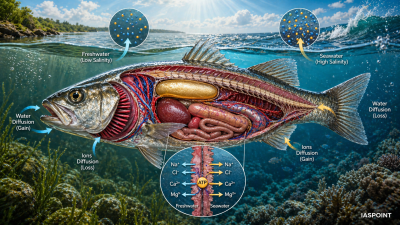
The physiology of fishes is defined by their ability to maintain homeostasis in a medium that is 800 times denser than air and varying in salinity.
1. Respiratory Physiology: Branchial Respiration
Fishes extract dissolved oxygen from water through their gills, utilizing a highly efficient exchange mechanism.
- Counter-current Exchange: This is the most critical physiological adaptation. Blood in the gill capillaries flows in the opposite direction to the water flowing over the gills. This maintains a favorable concentration gradient for oxygen along the entire length of the lamellae, allowing fishes to extract up to 90% of dissolved oxygen.
- Ventilation: Bony fishes use an “opercluar pump” (opening and closing the mouth and gill cover) to create a continuous flow. Cartilaginous fishes like sharks often use Ram Ventilation, where they must swim constantly with their mouths open to push water over the gills.
2. Circulatory Physiology: Single Circuit System
The fish heart is a “venous heart” because it only handles deoxygenated blood returning from the body.
- Heart Chambers: Consists of two primary chambers—one Atrium and one Ventricle. It also includes two accessory chambers: the Sinus Venosus (collection) and the Bulbus/Conus Arteriosus (dampening pressure).
- Circulation Path: Heart → Gills (Oxygenation) → Body Tissues (Deoxygenation) → Heart.
- Blood Characteristics: Most fishes have nucleated red blood cells containing hemoglobin. Note that Icefish (family Channichthyidae) are the only known vertebrates to lack hemoglobin, as oxygen dissolves more easily in the freezing Antarctic waters they inhabit.
3. Osmoregulation: Maintaining Salt-Water Balance
Fishes face different osmotic challenges depending on whether they live in freshwater or saltwater.
- Freshwater Fishes (Hypertonic to environment): Water constantly enters their body via osmosis.
- Adaptation: They do not drink water. They excrete large amounts of very dilute urine. Special “Chloride cells” in the gills actively pump salts (sodium and chloride) into the body from the water.
- Marine Fishes (Hypotonic to environment): Water constantly leaves their body.
- Adaptation: They actively drink seawater. They excrete very small amounts of concentrated urine. Chloride cells in the gills actively pump excess salts out of the body.
- Euryhaline Fishes: Certain species like Salmon or Hilsa can tolerate wide ranges of salinity and migrate between fresh and salt water.
4. Buoyancy Regulation: The Swim Bladder
Maintaining vertical position in the water column without expending energy is handled differently across classes.
- Bony Fishes (Osteichthyes): Possess a Swim Bladder (or Air Bladder). By adjusting the volume of gas within this sac, the fish can achieve neutral buoyancy.
- Physostomous: Bladder connected to the esophagus (fish gulps air).
- Physoclistous: Gas is exchanged via the blood using a “red gland” or gas gland.
- Cartilaginous Fishes (Chondrichthyes): Lack a swim bladder. They rely on a large, oil-rich liver (squalene oil is less dense than water) and their heterocercal tail to provide lift.
5. Sensory Physiology: The “Sixth Sense”
- Lateral Line System: A system of neuromasts (mechanoreceptors) that detect water vibrations and pressure changes, essential for schooling and detecting predators.
- Electroreception: Predominantly in sharks and rays. They use the Ampullae of Lorenzini—small pores on the snout—to detect the weak electrical fields generated by the muscle contractions of prey.
6. Thermoregulation
While 99% of fishes are Ectothermic (Poikilothermic), certain high-performance species like the Great White Shark and Bluefin Tuna exhibit Regional Endothermy. They use a “Rete Mirabile” (a complex of veins and arteries) to keep their swimming muscles and stomach warmer than the surrounding water, allowing for faster bursts of speed.
Comparison of Excretory Products
| Type of Fish | Primary Waste | Classification |
| Freshwater Bony Fish | Ammonia | Ammonotelic |
| Marine Bony Fish | Ammonia / Urea | Mixed |
| Cartilaginous Fish | Urea | Ureotelic |
UPSC Trivia: Migratory Physiology
- Anadromous Migration: Moving from Sea to Fresh water for breeding (e.g., Hilsa, Salmon).
- Catadromous Migration: Moving from Fresh water to Sea for breeding (e.g., Anguilla or True Eels).