

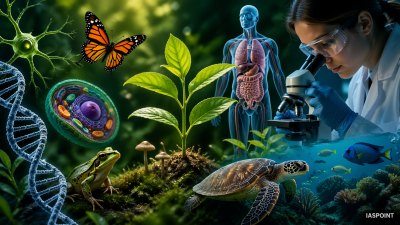
Biology is the natural science that studies life and living organisms, including their physical structure, chemical processes, molecular interactions, physiological mechanisms, development, and evolution.
Fundamental Branches of Biological Sciences
The study of biology is traditionally divided into three primary domains, though modern research often blurs these lines through interdisciplinary approaches:
- Zoology: The study of the animal kingdom, including structure, embryology, evolution, and classification.
- Botany: The scientific study of plants, including their physiology, structure, genetics, and ecology.
- Microbiology: The study of microscopic organisms, such as bacteria, viruses, archaea, fungi, and protozoa.
Characteristics of Living Organisms
To distinguish living matter from non-living matter, biologists use a specific set of criteria. An entity must generally exhibit the following:
- Cellular Organization: The cell is the basic structural and functional unit of life.
- Metabolism: The sum of all chemical reactions occurring within an organism, categorized into Anabolism (building up) and Catabolism (breaking down).
- Homeostasis: The ability to maintain a stable internal environment despite external changes.
- Growth and Development: Irreversible increase in mass or number of cells.
- Reproduction: The process of producing offspring, ensuring the continuity of the species.
- Response to Stimuli: Sensitivity to environmental changes (irritability).
The Hierarchy of Biological Organization
Biological complexity is organized in a hierarchical fashion, ranging from the microscopic to the global scale:
| Level | Description |
| Molecular Level | Atoms forming complex molecules like DNA, RNA, and proteins. |
| Cellular Level | The smallest unit of life (e.g., Neuron, RBC). |
| Tissue Level | Groups of similar cells performing a specific function (e.g., Xylem, Muscular tissue). |
| Organ Level | Different tissues working together (e.g., Heart, Leaf). |
| Organ System | Groups of organs performing complex functions (e.g., Circulatory system). |
| Organism | An individual living being. |
| Population | Group of individuals of the same species in a specific area. |
| Ecosystem | Biological community interacting with its physical environment. |
| Biosphere | The global sum of all ecosystems. |
Five Kingdom Classification System
Proposed by R.H. Whittaker (1969), this is the most widely accepted system for classifying living organisms based on cell structure, mode of nutrition, and body organization.
Kingdom Monera
- Consists of unicellular prokaryotes (lack a defined nucleus).
- Examples: Bacteria, Cyanobacteria (Blue-green algae), and Mycoplasma.
- Prelims Fact: Mycoplasmas are the smallest known living cells and can survive without oxygen.
Kingdom Protista
- Includes unicellular eukaryotes (possess a defined nucleus).
- Links plants, animals, and fungi.
- Examples: Amoeba, Paramecium, and Plasmodium (malarial parasite).
Kingdom Fungi
- Heterotrophic (mostly saprophytic) eukaryotic organisms.
- Cell walls are composed of Chitin.
- Examples: Yeast (unicellular), Mushrooms, and Penicillium.
Kingdom Plantae
- Multicellular, eukaryotic, and autotrophic organisms.
- Possess cellulosic cell walls and chlorophyll for photosynthesis.
Kingdom Animalia
- Multicellular, eukaryotic, and heterotrophic organisms.
- Lack cell walls and typically exhibit locomotion.
Important Biological Theories and Discoveries
Significant milestones in Biology that frequently appear in competitive examinations:
- Cell Theory: Formulated by Schleiden and Schwann (1839); states that all living things are composed of cells and cells are the basic unit of life. Rudolf Virchow later added that all cells arise from pre-existing cells (Omnis cellula-e cellula).
- Evolutionary Theory: Charles Darwin proposed the theory of “Natural Selection” in his book On the Origin of Species (1859).
- Genetic Inheritance: Gregor Mendel, known as the Father of Genetics, established the laws of inheritance through his work on pea plants (Pisum sativum).
- DNA Structure: James Watson and Francis Crick (1953) discovered the double-helix structure of DNA using X-ray diffraction data from Rosalind Franklin.
Biology Trivia for UPSC Aspirants
- Father of Biology: Aristotle.
- Father of Botany: Theophrastus.
- Father of Medicine: Hippocrates.
- The Term “Biology”: First coined by Lamarck and Treviranus in 1802.
- Smallest Unit of Life: The Cell.
- Largest Organ in the Human Body: Skin (External); Liver (Internal).
- Universal Energy Currency: ATP (Adenosine Triphosphate), produced in the mitochondria.
Key Biological Disciplines for Civil Services
| Discipline | Study of… |
| Cytology | Cell structure and function. |
| Histology | Tissues. |
| Genetics | Heredity and variations. |
| Paleontology | Fossils. |
| Taxonomy | Identification, nomenclature, and classification of organisms. |
| Physiology | Functions of living systems and organs. |
| Ecology | Interactions between organisms and their environment. |