

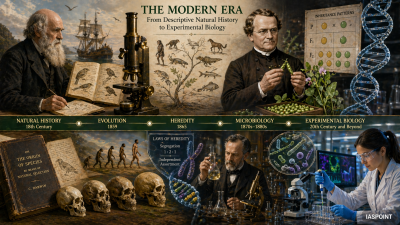
The modern era marked a transition from descriptive natural history to experimental biology, establishing the laws of heredity, evolution, and microbiology.
Charles Darwin (1809–1882): Evolutionary Biology
- Theory of Natural Selection: In his seminal work, On the Origin of Species (1859), Darwin proposed that individuals with traits better suited to their environment are more likely to survive and reproduce.
- The HMS Beagle Voyage: His observations of finches and tortoises in the Galápagos Islands provided the empirical evidence for “descent with modification.”
- Pangenesis: He incorrectly proposed “pangenesis” as a mechanism for heredity, which was later corrected by the discovery of genes.
Gregor Mendel (1822–1884): The Father of Genetics
- Experiments on Pea Plants: Working with Pisum sativum, Mendel identified the laws of inheritance: Law of Dominance, Law of Segregation, and Law of Independent Assortment.
- Unit of Inheritance: He coined the term “factors” (now known as genes) to describe the discrete units passed from parents to offspring.
Louis Pasteur (1822–1895): The Father of Microbiology
- Germ Theory of Disease: He proved that microorganisms are the cause of infectious diseases, debunking the theory of “spontaneous generation.”
- Pasteurization: Developed a process to kill microbes in liquids (like milk and wine) using heat.
- Vaccination: He developed the first vaccines for rabies and anthrax, utilizing attenuated (weakened) strains of the pathogen.
20th Century: The Molecular Revolution
This period saw the discovery of the structure of life at the molecular level, leading to the birth of biotechnology and genomics.
The DNA Pioneers
- James Watson and Francis Crick (1953): Proposed the double-helix model of DNA.
- Rosalind Franklin: Her X-ray diffraction image (Photo 51) was critical for determining the double-helical structure, though her contribution was recognized posthumously.
- Frederick Sanger: The only person to win two Nobel Prizes in Chemistry for work in biology: first for the structure of insulin and second for DNA sequencing methods (Sanger Sequencing).
Key Global Biologists of the 20th Century
- Barbara McClintock: Discovered “jumping genes” (transposons), proving that genetic material is not static.
- Alexander Fleming: Discovered Penicillin (1928), the world’s first true antibiotic, from the mold Penicillium notatum.
- Karl Landsteiner: Classified human blood into A, B, and O groups, making safe blood transfusions possible.
Modern Indian Biologists and Their Contributions
Indian scientists played a pivotal role in global genetics, agriculture, and ornithology.
| Scientist | Contribution / Discovery | Notable Detail |
| Jagadish Chandra Bose | Plant Physiology | Invented the Crescograph; proved plants respond to stimuli like sound and touch. |
| Har Gobind Khorana | Genetic Code | Won the 1968 Nobel Prize for deciphering how nucleotides control protein synthesis. |
| M.S. Swaminathan | Green Revolution | Father of the Green Revolution in India; developed high-yielding varieties (HYV) of wheat and rice. |
| Salim Ali | Ornithology | “Birdman of India”; conducted systematic bird surveys and wrote The Book of Indian Birds. |
| Janaki Ammal | Cytogenetics | Worked on sugarcane and eggplant; developed high-yielding hybrid sugarcane varieties. |
| Birbal Sahni | Paleobotany | Established the Birbal Sahni Institute of Palaeosciences; studied the plant fossils of the Gondwana region. |
| Dilip Mahalanabis | Oral Rehydration | Developed ORS during the 1971 refugee crisis, saving millions from cholera-induced dehydration. |
Contemporary Biologists and 21st Century Breakthroughs (Post-2000)
Contemporary biology is dominated by CRISPR, synthetic biology, and high-speed genome sequencing.
CRISPR-Cas9: Gene Editing
- Jennifer Doudna and Emmanuelle Charpentier: Awarded the Nobel Prize in 2020 for developing the CRISPR-Cas9 “genetic scissors.” This technology allows scientists to edit DNA sequences with unprecedented precision.
Contemporary Figures to Note
- Elizabeth Blackburn: Co-discovered Telomerase, the enzyme that protects chromosomes. Her work has implications for aging and cancer research.
- Tu Youyou: Discovered Artemisinin, a breakthrough malaria treatment derived from traditional Chinese medicine (Artemisia annua).
- Venkatraman Ramakrishnan: Indian-origin biologist who won the 2009 Nobel Prize for studying the structure and function of the ribosome.
UPSC Fact File: Biological Milestones
- Human Genome Project (1990–2003): An international effort that successfully mapped the entire human genetic sequence.
- Dolly the Sheep (1996): The first mammal cloned from an adult somatic cell by Ian Wilmut and his team.
- Synthetic Life (2010): Craig Venter created the first self-replicating synthetic bacterial cell (Synthia).
- mRNA Vaccines: Developed by scientists like Katalin Karikó and Drew Weissman, these were instrumental in the rapid response to the COVID-19 pandemic.