

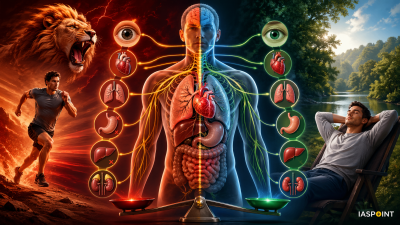
The Autonomic Nervous System (ANS) is bifurcated into the Sympathetic and Parasympathetic divisions. These two systems act antagonistically (opposingly) to maintain Homeostasis. While the Sympathetic system prepares the body for high-energy expenditure and emergency situations, the Parasympathetic system focuses on energy conservation and restorative processes.
I. Sympathetic Nervous System (The “Fight or Flight” Response)
This system is activated during physical or emotional stress, exercise, or perceived danger. It mobilizes the body’s resources for immediate action.
- Origin: Often called the Thoracolumbar Outflow because the pre-ganglionic neurons originate in the thoracic (T1) to lumbar (L2) segments of the spinal cord.
- Neurotransmitters: Uses Acetylcholine at the ganglion and Norepinephrine (Noradrenaline) at the effector organ.
- Key Physiological Actions:
- Heart: Increases heart rate and the force of contraction to pump more blood.
- Lungs: Relaxes smooth muscles in the bronchioles (Bronchodilation) to increase oxygen intake.
- Liver: Stimulates Glycogenolysis (breakdown of glycogen to glucose) to provide instant energy.
- Adrenal Medulla: Triggers the release of Epinephrine (Adrenaline) into the bloodstream, creating a systemic hormonal response.
- Skin/Digestion: Constricts blood vessels in the skin and digestive tract (Vasoconstriction) to divert blood to skeletal muscles.
II. Parasympathetic Nervous System (The “Rest and Digest” Response)
This system dominates during quiet, non-stressful conditions. It aims to conserve energy and handle “housekeeping” tasks like digestion and waste elimination.
- Origin: Often called the Craniosacral Outflow because the nerves originate from the brainstem (Cranial Nerves III, VII, IX, and X) and the sacral (S2–S4) region of the spinal cord.
- Neurotransmitters: Uses Acetylcholine at both the ganglion and the effector organ.
- Key Physiological Actions:
- Heart: Decreases heart rate to resting levels.
- Digestive Tract: Stimulates peristalsis (muscle contractions) and the secretion of digestive enzymes.
- Eyes: Constricts the pupil (Miosis) and aids in near-vision focusing.
- Gallbladder: Stimulates the release of bile.
- Bladder: Contracts the bladder wall and relaxes the internal urethral sphincter to facilitate urination.
III. Comparative Analysis for UPSC Prelims
| Feature | Sympathetic System | Parasympathetic System |
| Primary Goal | Energy Expenditure / Emergency | Energy Conservation / Recovery |
| Common Name | Fight or Flight | Rest and Digest |
| Anatomical Origin | Thoracic and Lumbar Spinal Cord | Brainstem and Sacral Spinal Cord |
| Ganglia Location | Close to the spinal cord (Sympathetic Chain) | Close to or within the effector organ |
| Post-ganglionic Fiber | Long | Short |
| Pupil of Eye | Dilates (Mydriasis) | Constricts (Miosis) |
| Saliva Production | Decreased (Dry mouth) | Increased |
| Blood Pressure | Increases | Decreases / Stabilizes |
IV. The Role of the Vagus Nerve (Cranial Nerve X)
The Vagus nerve is the most significant component of the Parasympathetic system. It carries approximately 75% of all parasympathetic nerve fibers. It provides the primary nerve supply to the heart, lungs, esophagus, stomach, and most of the small and large intestines. For Prelims, it is essential to note that Vagus nerve stimulation leads to a decrease in heart rate (Bradycardia).
V. UPSC Prelims Fact File
- Antagonistic Control: Most visceral organs receive dual innervation, meaning they are supplied by both systems. Their balance determines the organ’s activity level.
- Adrenergic vs. Cholinergic: Sympathetic post-ganglionic neurons are typically Adrenergic (releasing norepinephrine), while Parasympathetic post-ganglionic neurons are Cholinergic (releasing acetylcholine).
- Exception in Sympathetic System: Sympathetic nerves to sweat glands are unique because they release Acetylcholine instead of Norepinephrine.
- Mydriasis vs. Miosis: Sympathetic activation causes Mydriasis (dilation), while Parasympathetic activation causes Miosis (constriction). This is often used as a clinical diagnostic tool.
- Homeostatic Integration: The Hypothalamus in the brain acts as the master control center that decides whether to trigger the sympathetic or parasympathetic response based on internal and external stimuli.