

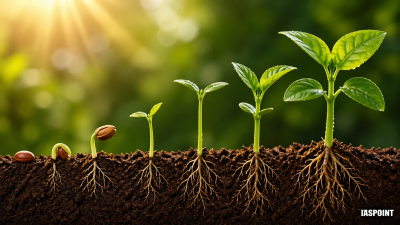
Plant growth is an irreversible, permanent increase in the size of an organ or its parts, or even an individual cell. In plants, growth is unique because they retain the capacity for unlimited growth throughout their life due to the presence of meristems at certain locations in their body.
Characteristics of Plant Growth
- Open Form of Growth: New cells are perpetually added to the plant body by the activity of meristems.
- Measurability: At a cellular level, growth is essentially a consequence of increase in the amount of protoplasm. It is measured by parameters such as increase in fresh weight, dry weight, length, area, volume, and cell number.
- Localization: Unlike animals, growth is confined to specific regions called meristems (Apical, Lateral, and Intercalary).
Phases of Plant Growth
The period of growth is generally divided into three distinct phases.
Meristematic Phase
This phase occurs at the root and shoot apices. The cells in this region are characterized by:
- Rich protoplasm and large, conspicuous nuclei.
- Thin and cellulosic primary cell walls with abundant plasmodesmatal connections.
- High rate of respiration and rapid cell division.
Elongation Phase
Cells proximal to the meristematic zone constitute the phase of elongation. Key features include:
- Increased vacuolation and cell enlargement.
- New cell wall deposition (thickening).
- Significant increase in the overall length of the plant organ.
Maturation Phase
Further away from the apex, more proximal to the phase of elongation, lies the phase of maturation.
- Cells attain their maximal size in terms of wall thickening and protoplasmic modifications.
- Most of the tissues and cell types identified in a plant (e.g., xylem, phloem, parenchyma) reach their final structural and functional form here.
Growth Rates and Mathematical Expressions
Growth rate is the increased growth per unit time. It can be expressed mathematically in two ways:
Arithmetic Growth
In arithmetic growth, following mitotic cell division, only one daughter cell continues to divide while the other differentiates and matures.
- Expression: Lt = L0 + rt
- Parameters: Lt = length at time ‘t’; L0 = length at time ‘zero’; r = growth rate/elongation per unit time.
- Example: Constant elongation of a root.
Geometric Growth
In most systems, the initial growth is slow (lag phase), followed by a rapid increase (log or exponential phase), and finally slows down as nutrients become limiting (stationary phase).
- Expression: W1 = W0 ert
- Parameters: W1 = final size; W0 = initial size; r = relative growth rate (efficiency index); t = time; e = base of natural logarithms.
- Sigmoid Curve: A typical S-shaped curve is a characteristic of living organisms growing in a natural environment.
Differentiation, Dedifferentiation, and Redifferentiation
| Process | Definition | Example |
| Differentiation | Cells derived from meristems mature to perform specific functions, losing the ability to divide. | Tracheary elements (xylem) losing protoplasm. |
| Dedifferentiation | Living differentiated cells regain the capacity of division under certain conditions. | Formation of interfascicular cambium and cork cambium. |
| Redifferentiation | Dedifferentiated cells produce cells that once again lose the capacity to divide but mature to perform specific functions. | Secondary xylem, secondary phloem, or cork. |
Factors Affecting Plant Growth
- Water: Essential for cell enlargement and turgidity. It provides the medium for enzymatic activities.
- Oxygen: Required for the release of metabolic energy (ATP) necessary for growth activities.
- Nutrients: Macro and micro-elements are required for the synthesis of protoplasm and act as source of energy.
- Temperature: Plants have an optimum temperature range (usually 25-30°C) for maximum growth. Deviations can denature enzymes.
- Light and Gravity: These act as environmental signals that direct the orientation and stages of growth (e.g., phototropism and geotropism).
Development and Plasticity
Development is a broader term that includes all changes an organism goes through during its life cycle (from germination to senescence).
- Plasticity: Plants follow different pathways in response to environment or phases of life to form different kinds of structures.
- Heterophylly: A primary example of plasticity.
- Environmental Heterophylly: In Buttercup (Ranunculus), the leaves of terrestrial and aquatic habitats differ.
- Phase-based Heterophylly: In Cotton, Coriander, and Larkspur, the leaves of juvenile plants are different in shape from those in mature plants.
UPSC Trivia for Prelims
- Grand Period of Growth: The total time taken by a plant to complete all three phases (Lag, Log, and Stationary) is often referred to as the grand period of growth.
- Efficiency Index: In geometric growth, ‘r’ is the relative growth rate and is also a measure of the ability of the plant to produce new plant material.
- Open Differentiation: Just as growth in plants is open, differentiation is also open because cells arising out of the same meristem have different structures at maturity based on their final location (e.g., cells pushed to the periphery become epidermis).