

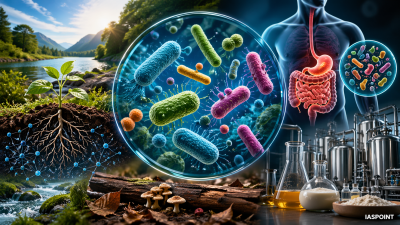
While bacteria are often associated with diseases, a vast majority are essential for life on Earth. They play critical roles in ecosystem services, human health, and industrial processes.
Role in Agriculture and Soil Fertility
Bacteria are the primary drivers of the nutrient cycles that sustain soil health and plant growth.
Nitrogen Fixation
Since plants cannot directly utilize atmospheric nitrogen (N2), bacteria convert it into usable forms like nitrates.
- Symbiotic Nitrogen Fixers: Rhizobium lives in the root nodules of leguminous plants (e.g., peas, beans). It fixes nitrogen in exchange for carbohydrates.
- Free-Living Nitrogen Fixers: Azotobacter and Clostridium fix nitrogen independently in the soil.
- Cyanobacteria: Nostoc and Anabaena are used as biofertilizers, particularly in rice paddies.
Decomposition and Mineralization
- Saprophytic Bacteria: These decompose dead organic matter into simpler inorganic substances, recycling carbon and minerals back into the soil.
- Nitrifying Bacteria: Nitrosomonas converts ammonia into nitrites, and Nitrobacter converts nitrites into nitrates.
Role in Food and Dairy Industry
Bacterial fermentation is the cornerstone of various food processing techniques.
- Curd and Cheese Production: Lactobacillus acidophilus converts lactose (milk sugar) into lactic acid, which coagulates milk proteins to form curd.
- Vinegar (Acetic Acid): Acetobacter aceti oxidizes ethanol into acetic acid.
- Probiotics: Live bacteria like Bifidobacterium that provide health benefits, particularly for the digestive system, when consumed.
Role in Medicine and Biotechnology
The pharmaceutical industry relies heavily on bacterial metabolism for the mass production of life-saving drugs.
Antibiotic Production
Many antibiotics used to treat human infections are derived from soil-dwelling bacteria.
| Antibiotic | Source Bacterium |
| Streptomycin | Streptomyces griseus |
| Tetracycline | Streptomyces aureofaciens |
| Erythromycin | Streptomyces erythreus |
| Bacitracin | Bacillus subtilis |
Genetic Engineering
- Insulin Production: Genetically modified E. coli is used to produce human insulin (Humulin) on a commercial scale.
- Vectors: Plasmids from Agrobacterium tumefaciens serve as vehicles to transfer desired genes into plants (e.g., Bt Cotton).
Environmental Applications (Bioremediation)
Bacteria are increasingly used to mitigate environmental pollution through a process called Bioremediation.
- Oil Spill Cleanup: “Superbug” (Pseudomonas putida), developed by Dr. Ananda Chakrabarty, can digest crude oil components.
- Sewage Treatment: In Secondary Treatment of sewage, aerobic bacteria (flocs) consume organic matter in effluent, reducing its Biochemical Oxygen Demand (BOD).
- Biogas Production: Methanogens (anaerobic bacteria) break down animal waste to produce methane (CH4), used as a clean fuel.
Summary Table of Useful Bacteria
| Category | Specific Bacterium | Function/Utility |
| Agriculture | Rhizobium | Nitrogen fixation in legumes |
| Dairy | Lactobacillus | Milk to curd fermentation |
| Medical | Streptomyces | Production of various antibiotics |
| Environment | Pseudomonas putida | Cleaning oil spills (Bioremediation) |
| Human Body | Escherichia coli | Synthesizes Vitamin K and B12 in the human gut |
Fact-Sheet for UPSC Prelims
- Gut Microbiota: The human large intestine houses trillions of bacteria that help in digestion, prevent pathogen colonization, and synthesize essential vitamins.
- Single Cell Protein (SCP): Methylophilus methylotrophus has a high rate of biomass production and is used as a protein-rich food supplement.
- Botox: Though it is a toxin produced by Clostridium botulinum, in extremely diluted forms, it is used medically to treat muscle spasms and in cosmetic procedures.
- Enzymes: Thermus aquaticus provides the Taq Polymerase enzyme, which is heat-stable and essential for the Polymerase Chain Reaction (PCR) technique used in DNA amplification and COVID-19 testing.