

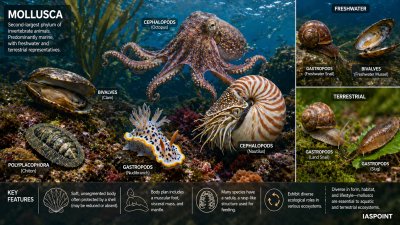
Mollusca represents the second-largest phylum of invertebrate animals, following Arthropoda. These organisms are predominantly marine, though several species inhabit freshwater and terrestrial ecosystems.
General Characteristics and Taxonomy
Molluscs are characterized by a soft-bodied structure, typically protected by a calcareous shell. They exhibit a higher level of organization compared to lower invertebrates.
- Level of Organization: Organ-system level of organization.
- Symmetry: Primarily bilaterally symmetrical. However, in Gastropods (e.g., snails), adults may become asymmetrical due to torsion during development.
- Germ Layers: Triploblastic (comprising ectoderm, mesoderm, and endoderm).
- Coelom: True coelomates, though the coelom is often restricted to a small space around the heart (pericardial cavity) and gonads.
Body Organization and Anatomy
The body of a mollusc is unsegmented (with the exception of Neopilina) and is typically divided into four distinct regions:
1. Head and Sensory Organs
The anterior region usually contains the mouth and sensory structures such as eyes and tentacles.
2. Muscular Foot
A ventral, muscular structure used primarily for locomotion, burrowing, or attachment. In Cephalopods (e.g., Octopus), the foot is modified into tentacles.
3. Visceral Hump (Mass)
A dorsal mass containing the vital internal organs (digestive, excretory, and reproductive systems).
4. Mantle and Pallial Cavity
- Mantle (Pallium): A soft, spongy layer of skin that covers the visceral hump.
- Mantle Cavity: The space between the visceral hump and the mantle. It houses the ctenidia (feather-like gills) used for respiration and excretion.
- Shell: Secreted by the mantle; composed primarily of calcium carbonate (CaCO3). It can be external (Snail), internal (Squid), or absent (Octopus).
Physiological Systems
| System | Key Features |
| Digestive System | Complete system. Features a rasping organ called the Radula (chitinous teeth) for feeding, except in Bivalves. |
| Circulatory System | Generally Open Type (blood flows through sinuses). Exception: Cephalopods (Octopus, Squid) have a Closed Circulatory System. |
| Respiratory System | Gills (Ctenidia) in aquatic forms; pulmonary sac (lungs) in terrestrial forms. |
| Excretory System | One or two pairs of kidneys or Organ of Bojanus (metanephridia). Keber’s organ is also found in some. |
| Nervous System | Consists of paired ganglia (cerebral, visceral, and pedal) connected by commissures and connectives. |
Reproduction and Development
- Dioecious: Most molluscs have separate sexes, though some are hermaphroditic.
- Fertilization: Can be external (aquatic) or internal.
- Development: Usually indirect, passing through larval stages such as Trochophore, Veliger, or Glochidium.
Classification and Major Classes
| Class | Key Characteristics | Examples |
| Monoplacophora | Segmented; considered a “living fossil” connecting Annelida and Mollusca. | Neopilina |
| Gastropoda | Undergo torsion; single-piece shell. | Pila (Apple Snail), Helix (Garden Snail) |
| Bivalvia (Pelecypoda) | Shell consists of two valves; lacks a radula. | Unio (Freshwater mussel), Pinctada (Pearl Oyster) |
| Cephalopoda | Closed circulation; foot modified into tentacles; ink glands for defense. | Sepia (Cuttlefish), Loligo (Squid), Octopus (Devilfish) |
| Polyplacophora | Shell consists of eight dorsal plates. | Chiton |
| Scaphopoda | Tusk-shaped shell open at both ends. | Dentalium (Tusk shell) |
Important Facts and Trivia for Prelims
- Living Fossil: Neopilina is the only mollusc that shows internal segmentation, linking it to Annelids.
- The Ink Gland: Found in Cephalopods like Sepia; it releases a dark fluid to confuse predators.
- Pearl Formation: Produced by Pinctada vulgaris. When a foreign particle enters between the shell and mantle, the mantle secretes nacre (mother of pearl) around it.
- Blue Blood: Mollusc blood often contains Hemocyanin, a copper-based pigment, which appears blue when oxygenated.
- Largest Invertebrate: The Giant Squid (Architeuthis) is one of the largest known molluscs and invertebrates.
- Torsion: A unique process in Gastropods where the visceral mass rotates 180°, bringing the anus to a position above the head.
Economic and Ecological Significance
- Source of Food: Mussels, oysters, and squids are major protein sources in many coastal economies.
- Jewelry: Pearls and shells (Conch/Sankha) have significant commercial and cultural value.
- Agricultural Pests: Certain snails and slugs cause damage to crops and gardens.
- Bio-indicators: Molluscs are often used to monitor the health of aquatic ecosystems due to their sensitivity to pollutants.