

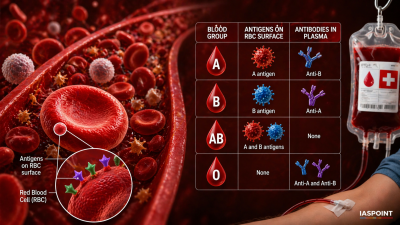
The classification of blood into groups is determined by the presence or absence of specific antigens (proteins) on the surface of Red Blood Cells (RBCs) and antibodies (immunoglobulins) in the plasma. This system is critical for blood transfusions to prevent immunological reactions.
The ABO Blood Group System
The ABO system is based on two surface antigens on the RBCs, namely A and B. The plasma of different individuals also contains two natural antibodies (anti-A and anti-B). This system was discovered by Karl Landsteiner (Nobel Prize, 1930).
- Antigens: Chemical substances that can induce an immune response. They are located on the RBC membrane.
- Antibodies: Proteins produced by B-lymphocytes in response to antigens. They are located in the blood plasma.
Distribution of Antigens and Antibodies
| Blood Group | Antigen on RBCs | Antibody in Plasma | Can Donate To | Can Receive From |
| A | A | anti-B | A, AB | A, O |
| B | B | anti-A | B, AB | B, O |
| AB | A and B | None | AB | A, B, AB, O |
| O | None | anti-A, anti-B | A, B, AB, O | O |
Universal Donors and Recipients
- Universal Donor: Blood Group O (specifically O negative) is called the universal donor because it lacks A and B antigens, meaning it does not provoke an immune response in any recipient.
- Universal Recipient: Blood Group AB (specifically AB positive) is called the universal recipient because it lacks both anti-A and anti-B antibodies, allowing it to receive blood from any group without a reaction.
The Rh Factor (Rhesus Factor)
The Rh antigen is another surface protein found on the RBCs of nearly 80% of humans. It was first discovered in the Rhesus monkey.
- Rh Positive (Rh+ve): Individuals possessing the Rh antigen.
- Rh Negative (Rh-ve): Individuals lacking the Rh antigen.
An Rh-negative person, if exposed to Rh-positive blood, will develop specific antibodies against the Rh antigens. Therefore, Rh group matching is essential before transfusion.
Erythroblastosis Fetalis (HDN)
This is a specific Rh incompatibility condition that occurs during pregnancy.
- The Condition: It arises when an Rh-negative mother carries an Rh-positive fetus.
- Mechanism: During the first delivery, there is a possibility of the mother’s blood being exposed to small amounts of Rh-positive blood from the fetus. The mother’s immune system starts preparing antibodies against Rh antigens.
- Subsequent Pregnancies: In case of a subsequent pregnancy with an Rh-positive fetus, the Rh antibodies from the mother can leak into the blood of the fetus and destroy the fetal RBCs.
- Consequences: This can be fatal to the fetus or could cause severe anemia and jaundice to the baby.
- Prevention: This can be avoided by administering anti-Rh antibodies (RhoGAM) to the mother immediately after the delivery of the first child.
Genetic Inheritance of Blood Groups
ABO blood grouping is an example of Multiple Allelism and Co-dominance in genetics. It is controlled by the Gene I (Isohemoagglutinin).
- The gene has three alleles: IA, IB, and i.
- IA and IB are dominant over i.
- When IA and IB are present together, both express themselves equally (Co-dominance), resulting in blood group AB.
Critical Facts for UPSC Prelims
- Bombay Blood Group: An extremely rare blood type (h/h) discovered in Mumbai (1952). These individuals lack the ‘H’ antigen, which is the precursor to A and B antigens. They can only receive blood from another Bombay Blood Group individual.
- Agglutination: The clumping of RBCs that occurs when an antibody meets its corresponding antigen (e.g., anti-A meeting Antigen A), leading to hemolysis.
- Landsteiner’s Law: States that if an antigen is present on the RBCs, the corresponding antibody must be absent in the plasma; conversely, if an antigen is absent, the corresponding antibody must be present.
- Transfusion Mismatch: If mismatched blood is given, the recipient’s antibodies attack the donor’s RBCs, leading to kidney failure or death.