

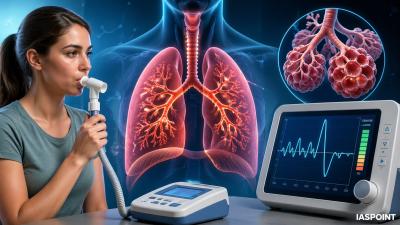
Respiratory volumes refer to the quantity of air that the lungs can hold, inhale, or exhale under varying conditions. These measurements are clinical indicators of pulmonary health and are measured using a Spirometer.
Standard Respiratory Volumes
These are the four primary independent measurements of air volume in the respiratory cycle.
| Volume Term | Definition | Average Value (Adult Male) |
| Tidal Volume (TV) | Volume of air inspired or expired during a normal, relaxed breath. | 500 mL |
| Inspiratory Reserve Volume (IRV) | Additional volume of air that can be forcibly inspired after a normal inspiration. | 2500 – 3000 mL |
| Expiratory Reserve Volume (ERV) | Additional volume of air that can be forcibly expired after a normal expiration. | 1000 – 1100 mL |
| Residual Volume (RV) | Volume of air remaining in the lungs even after the most forceful expiration. | 1100 – 1200 mL |
Respiratory Capacities
Capacities are derived by adding two or more respiratory volumes together. They provide a broader picture of a person’s pulmonary state.
Inspiratory Capacity (IC)
Total volume of air a person can inspire after a normal expiration (TV + IRV). It represents the maximum air one can take into the lungs.
Expiratory Capacity (EC)
Total volume of air a person can expire after a normal inspiration (TV + ERV).
Functional Residual Capacity (FRC)
Volume of air that remains in the lungs after a normal expiration (ERV + RV). This air prevents the alveoli from collapsing and allows for continuous gas exchange between breaths.
Vital Capacity (VC)
The maximum volume of air a person can breathe in after a forced expiration, or the maximum air one can breathe out after a forced inspiration (ERV + TV + IRV).
- Significance: It is a vital indicator of an individual’s lung health and physical fitness. Athletes and mountain dwellers typically have a higher Vital Capacity.
Total Lung Capacity (TLC)
Total volume of air accommodated in the lungs at the end of a forced inspiration (RV + ERV + TV + IRV or VC + RV).
- Average Value: Approximately 5000 – 6000 mL.
Comparative Summary Table
| Capacity | Formula | Significance |
| IC | TV + IRV | Maximal inspiration potential. |
| FRC | ERV + RV | Reservoir for gas exchange during rest. |
| VC | TV + IRV + ERV | Total “useful” air for the body. |
| TLC | VC + RV | Absolute total volume of the lungs. |
Important Facts for UPSC
- The “Dead Space”: Not all inspired air reaches the alveoli for exchange. About 150 mL of the Tidal Volume stays in the conducting passages (trachea, bronchi) and is known as Anatomical Dead Space.
- Residual Volume Observation: Residual volume cannot be measured directly by a simple spirometer because this air never leaves the lungs; specialized gas dilution techniques are required.
- Minute Ventilation: The total volume of air shifted in one minute. Calculated as: Respiratory Rate × Tidal Volume. (Average: 12 × 500 = 6000 mL/min).
- Effect of Smoking: Conditions like Emphysema lead to the destruction of alveolar walls, increasing the Residual Volume but significantly decreasing the Vital Capacity.
- Altitude Adaptation: At high altitudes, the body compensates for low pO2 by increasing the breathing rate and eventually increasing the RBC count, though Vital Capacity remains a relatively stable trait of the individual.