

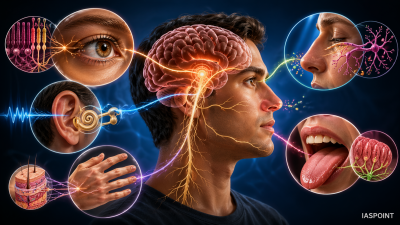
Human beings possess specialized organs that receive external stimuli and transmit them to the central nervous system. These organs—Eyes, Ears, Nose, Tongue, and Skin—contain specialized cells called receptors.
The Eye: Photoreception
The eyes are situated in the orbits of the skull and are responsible for vision. They detect light and convert it into electrochemical impulses in neurons.
Structural Anatomy of the Eye
- Sclera: The outermost white protective layer. The anterior transparent portion is the Cornea.
- Choroid: The middle vascular layer which contains blood vessels. It forms the Ciliary Body and the Iris.
- Retina: The innermost layer containing three layers of neural cells: ganglion cells, bipolar cells, and photoreceptor cells.
Photoreceptor Cells
| Cell Type | Function | Pigment |
| Rods | Twilight/Scotopic vision (low light) | Rhodopsin (Visual Purple) |
| Cones | Daylight/Photopic vision and Color vision | Iodopsin (Visual Violet) |
Key Facts for Prelims
- Fovea Centralis: A thinned-out portion of the retina where only cones are densely packed; it is the point of greatest visual acuity (resolution).
- Blind Spot: The region where the optic nerve leaves the eye; it lacks photoreceptor cells.
- Vitamin A Connection: Rhodopsin is a derivative of Vitamin A; its deficiency leads to Night Blindness.
The Ear: Phono-reception and Equilibrium
The ear serves two distinct functions: hearing and the maintenance of body balance (equilibrium).
Divisions of the Human Ear
- Outer Ear: Consists of the Pinna and the external auditory canal. It collects sound waves.
- Middle Ear: Contains three ossicles—Malleus (Hammer), Incus (Anvil), and Stapes (Stirrup). The Stapes is the smallest bone in the human body.
- Inner Ear: Also called the Labyrinth. It consists of the Bony Labyrinth and the Membranous Labyrinth.
Mechanics of Hearing and Balance
- Organ of Corti: Located on the basilar membrane of the cochlea; it contains hair cells that act as auditory receptors.
- Vestibular Apparatus: Located above the cochlea, consisting of Semicircular canals and the Otolith organ (Saccule and Utricle). It is responsible for maintaining static and dynamic equilibrium.
The Nose: Olfactory Reception
The nose contains mucus-coated receptors called Olfactory Receptors which are specialized for detecting dissolved chemical substances (Odorence).
Olfactory Mechanism
- Olfactory Epithelium: Consists of olfactory receptor cells, basal cells, and supporting cells.
- Olfactory Bulb: An extension of the brain’s limbic system. Humans can distinguish several thousand different odors, though the sense of smell is less developed in humans than in many other mammals (Macrosmatic vs. Microsmatic).
The Tongue: Gustatory Reception
The tongue is a muscular organ responsible for the sense of taste (Gustation) and aiding in speech and deglutition (swallowing).
Taste Buds and Papillae
The surface of the tongue has projections called Papillae, some of which contain taste buds.
- Gustatory Receptors: These detect dissolved chemicals from food.
- Primary Tastes: Historically categorized into Sweet, Sour, Salt, and Bitter. A fifth taste, Umami (savory), is now globally recognized.
- Interaction: Smell and taste are closely linked; the flavor of food is a combination of gustatory and olfactory inputs.
The Skin: Somatosensory System
The skin is the largest organ of the body and provides the sense of touch (Tactile reception). It contains various receptors sensitive to pressure, temperature, and pain.
Specialized Receptors in Skin
| Receptor Name | Stimulus Detected |
| Meissner’s Corpuscles | Light touch/Low-frequency vibration |
| Pacinian Corpuscles | Deep pressure/High-frequency vibration |
| Ruffini Endings | Skin stretch/Warmth |
| Krause End Bulbs | Cold |
| Nociceptors | Pain (Mechanical, Thermal, or Chemical damage) |
Summary Table: Receptors and Stimuli
| Sense | Organ | Receptor Type | Stimulus |
| Vision | Eye | Photoreceptor | Electromagnetic radiation (Light) |
| Hearing | Ear | Mechanoreceptor (Phonoreceptor) | Sound Waves |
| Balance | Inner Ear | Mechanoreceptor | Gravity and Motion |
| Smell | Nose | Chemoreceptor (Olfactory) | Volatile Chemicals |
| Taste | Tongue | Chemoreceptor (Gustatory) | Soluble Chemicals |
| Touch | Skin | Mechanoreceptor/Thermoreceptor | Pressure, Heat, Cold |
Trivia and Scientific Facts for UPSC
- Accommodation: The ability of the eye to adjust its focal length to see objects at varying distances, managed by the ciliary muscles.
- Eustachian Tube: Connects the middle ear cavity with the pharynx; it helps in equalizing air pressure on either side of the eardrum.
- Synesthesia: A neurological condition where the stimulation of one sensory pathway leads to involuntary experiences in a second sensory pathway (e.g., “seeing” sounds).
- Transient Receptor Potential (TRP) Channels: These are the molecular basis for temperature sensation in the skin, for which the Nobel Prize in Physiology or Medicine 2021 was awarded (David Julius and Ardem Patapoutian).