

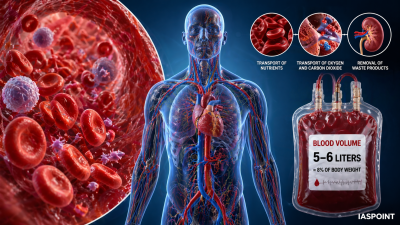
Blood is a specialized fluid connective tissue essential for maintaining the body’s internal environment (homeostasis). It circulates through the cardiovascular system, facilitating the transport of nutrients, gases, and waste products. In an average adult, blood volume is approximately 5 to 6 liters, accounting for roughly 8% of total body weight.
Composition of Blood
Blood is composed of two primary components: Plasma (the liquid matrix) and Formed Elements (cells and cell fragments).
1. Plasma (55% of Blood Volume)
Plasma is a straw-colored, slightly alkaline (pH ~7.4) fluid. It consists of:
- Water (90-92%): Acts as a solvent for transporting various substances.
- Plasma Proteins (6-8%):
- Albumin: Maintains osmotic pressure and water balance.
- Globulins: Primarily involved in defense mechanisms (antibodies/immunoglobulins).
- Fibrinogen: Essential for blood clotting (coagulation).
- Nutrients and Waste: Glucose, amino acids, lipids, urea, and creatinine.
- Electrolytes: Sodium (Na^+), Potassium (K^+), Calcium (Ca2+), and Bicarbonate (HCO3^-).
2. Formed Elements (45% of Blood Volume)
This category includes Erythrocytes, Leukocytes, and Thrombocytes.
| Cell Type | Technical Name | Primary Function | Lifespan |
| Red Blood Cells (RBCs) | Erythrocytes | Transport O2 and CO2 via Hemoglobin. | ~120 Days |
| White Blood Cells (WBCs) | Leukocytes | Immune defense and inflammatory response. | Variable (Days to Years) |
| Platelets | Thrombocytes | Blood clotting and wound healing. | 7-10 Days |
Detailed Analysis of Formed Elements
Erythrocytes (RBCs)
- Structure: Biconcave discs that lack a nucleus and mitochondria at maturity (to maximize space for hemoglobin).
- Hemoglobin: An iron-rich protein that binds reversibly with oxygen (O2).
- Production: Occurs in the red bone marrow through a process called Erythropoiesis, stimulated by the hormone Erythropoietin (secreted by kidneys).
Leukocytes (WBCs)
Leukocytes are the only “complete” cells in the blood, containing a nucleus and organelles. They are divided into two groups:
- Granulocytes: Contain granules in the cytoplasm.
- Neutrophils: Most abundant; first responders to bacterial infection (Phagocytosis).
- Eosinophils: Combat parasitic infections and mediate allergic reactions.
- Basophils: Release histamine and heparin; involved in inflammation.
- Agranulocytes: Lack visible granules.
- Lymphocytes: B-cells (produce antibodies) and T-cells (direct cell-killing); vital for adaptive immunity.
- Monocytes: Largest WBCs; transform into macrophages to engulf pathogens.
- Granulocytes: Contain granules in the cytoplasm.
Thrombocytes (Platelets)
- Origin: Cell fragments derived from large bone marrow cells called Megakaryocytes.
- Function: When a vessel is damaged, platelets adhere to the site and release clotting factors (e.g., Thromboplastin) to form a “platelet plug.”
Vital Functions of Blood
- Transport: Delivers oxygen from lungs to tissues and carbon dioxide from tissues to lungs. It carries hormones from endocrine glands to target organs.
- Regulation: Maintains body temperature by distributing heat; regulates pH levels via buffer systems (bicarbonate).
- Protection: Prevents blood loss through the clotting mechanism; protects against pathogens via WBCs and antibodies.
- Excretion: Transports metabolic waste products (urea, uric acid) to the kidneys and liver for elimination.
Important Facts for UPSC Prelims
- Serum vs. Plasma: Serum is plasma minus the clotting factors (Fibrinogen). It is used for various diagnostic blood tests.
- Hematocrit: The percentage of total blood volume occupied by RBCs. Lower levels indicate anemia, while higher levels suggest polycythemia.
- Blood Groups: Determined by specific antigens (A, B, or Rh) on the surface of RBCs.
- Universal Donor: O-negative (O^-) as it lacks A, B, and Rh antigens.
- Universal Recipient: AB-positive (AB^+) as it possesses all major antigens.
- Hemolysis: The destruction of RBCs, which occurs primarily in the Spleen (often called the “Graveyard of RBCs”).
- Carbon Monoxide Poisoning: CO has a 200 times higher affinity for hemoglobin than oxygen, forming carboxyhemoglobin, which prevents oxygen delivery to tissues.
- Diapedesis: The unique ability of WBCs to squeeze through capillary walls to reach sites of tissue infection.