

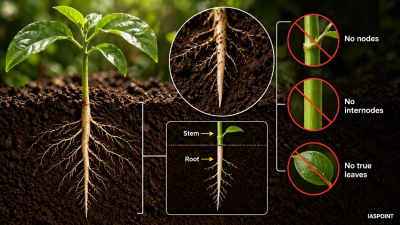
The root is the descending, non-green, underground part of the plant axis. It lacks nodes, internodes, and true leaves.
Structural Zones of a Root
The root tip is organized into distinct regions, each performing a specific physiological role.
- Root Cap (Calyptra): A thimble-like structure covering the apex. It protects the tender growing point and secretes mucilage to lubricate the root’s passage through the soil. (Note: Root caps are absent in aquatic plants like Pistia and Eichhornia, where root pockets are present instead).
- Zone of Meristematic Activity: Located just above the root cap. Cells here are small, thin-walled, with dense protoplasm; they divide repeatedly to facilitate growth.
- Zone of Elongation: Cells proximal to the meristematic region undergo rapid enlargement and stretching, responsible for the growth of the root in length.
- Zone of Maturation: Cells differentiate into various mature tissues (Epidermis, Cortex, Xylem, Phloem).
- Root Hairs: Fine, delicate, thread-like structures formed by epidermal cells in the maturation zone. These are the primary sites for water and mineral absorption.
Classification of Root Systems
Roots are classified based on their origin and branching pattern.
| Root Type | Origin | Characteristics | Examples |
| Tap Root | Radicle | A persistent primary root that produces lateral branches (secondary and tertiary roots). | Mustard, Peepal, Gram |
| Fibrous Root | Base of Stem | Primary root is short-lived; replaced by a dense network of thin roots. | Wheat, Paddy, Maize |
| Adventitious Root | Any part except Radicle | Roots arising from leaves, nodes, or internodes. | Banyan, Grass, Monstera |
Physiological and Mechanical Functions
- Absorption: Primary function of absorbing water and essential minerals from the soil.
- Anchorage: Providing a firm longitudinal and lateral hold to the plant in the soil.
- Storage: Reservoirs for reserve food materials.
- Synthesis: Sites for the synthesis of certain Plant Growth Regulators (PGRs) like cytokinins.
Morphological Modifications for Survival
In several species, roots deviate from their primary functions to perform specialized tasks.
1. Storage Roots (Modified Tap Roots)
- Fusiform: Thicker in the middle and tapering towards both ends (e.g., Radish).
- Conical: Broadest at the base and tapering gradually toward the apex (e.g., Carrot).
- Napiform: Spherical at the upper end and abruptly tapering at the lower end (e.g., Turnip, Beetroot).
2. Respiratory Roots (Pneumatophores)
- Found in plants growing in saline marshes (Halophytes) where oxygen is scarce in the soil.
- These roots grow vertically upward (negatively geotropic) and possess small pores called Lenticels or Pneumathodes for gas exchange.
- Examples: Rhizophora, Avicennia, and Sonneratia (Mangrove vegetation).
3. Mechanical Support Modifications
- Prop Roots: Pillar-like roots hanging from aerial branches to support heavy horizontal limbs (e.g., Banyan tree).
- Stilt Roots: Oblique roots arising from the lower nodes of the stem to provide extra stability (e.g., Sugarcane, Maize).
4. Vital/Specialized Functions
- Photosynthetic (Assimilatory) Roots: Green roots capable of photosynthesis (e.g., Trapa, Tinospora).
- Parasitic (Haustorial) Roots: Specialized roots that penetrate the host plant tissues to suck nutrients (e.g., Cuscuta or Dodder).
- Nodulated Roots: Roots containing nitrogen-fixing bacteria (Rhizobium) in nodules; characteristic of the Leguminosae family (e.g., Pea, Beans).
UPSC Trivia: Quick Facts for Prelims
- Geotropism: Roots are generally positively geotropic (grow toward gravity) and negatively phototropic (grow away from light).
- Epiphytic Roots: Found in Orchids; they possess a specialized moisture-absorbing tissue called Velamen.
- Mycorrhiza: A symbiotic association between a fungus and the roots of higher plants (e.g., Pinus), enhancing phosphorus absorption.
- Edible Roots vs. Stems: Sweet potato is a modified root, whereas a common potato is a modified stem (tuber). Both store starch but have different morphological origins.