

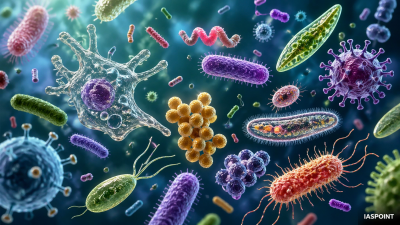
Microorganisms are microscopic organisms that exist as unicellular, multicellular, or cell clusters.
Bacteria: The Prokaryotic Pioneers
Bacteria are single-celled prokaryotic organisms belonging to the Kingdom Monera. They lack a defined nucleus and membrane-bound organelles.
Structural Classification by Shape
Bacteria are primarily classified based on their physical morphology:
- Cocci: Spherical or oval-shaped bacteria (e.g., Streptococcus pneumoniae).
- Bacilli: Rod-shaped bacteria (e.g., Bacillus anthracis, Lactobacillus).
- Spirilla: Spiral-shaped bacteria (e.g., Treponema pallidum).
- Vibrio: Comma-shaped bacteria (e.g., Vibrio cholerae).
Classification based on Gram Staining
Developed by Hans Christian Gram, this method differentiates bacteria based on their cell wall composition:
- Gram-Positive Bacteria: These retain the crystal violet stain due to a thick peptidoglycan layer in the cell wall (e.g., Staphylococcus).
- Gram-Negative Bacteria: These do not retain the stain and appear red/pink; they possess a thinner peptidoglycan layer and an outer lipid membrane, often making them more resistant to antibiotics (e.g., E. coli).
Economic and Biological Significance
- Nitrogen Fixation: Bacteria like Rhizobium (in root nodules) and Azotobacter (free-living) convert atmospheric nitrogen into nitrates.
- Human Health: They aid in digestion (gut microbiota) and the production of Vitamin K.
- Industrial Use: Lactobacillus is used in curdling milk; Streptomyces is used in antibiotic production.
Viruses: The Obligate Intracellular Parasites
Viruses are sub-microscopic infectious agents that replicate only inside the living cells of an organism. They consist of genetic material (DNA or RNA) encased in a protein coat called a capsid.
Key Characteristics and Trivia
- Virology: The study of viruses.
- Living vs. Non-living: They are considered non-living outside a host because they cannot perform metabolic functions; they are considered living inside a host as they replicate.
- Genetic Material: A virus contains either DNA or RNA, never both.
Classification based on Host Type
- Bacteriophages: Viruses that infect bacteria (often used in phage therapy).
- Phytophagineae: Plant viruses, mostly containing single-stranded RNA (e.g., Tobacco Mosaic Virus).
- Zoophagineae: Animal viruses, which can contain either DNA or RNA (e.g., Influenza, HIV, SARS-CoV-2).
Comparative Analysis: Bacteria vs. Viruses
| Feature | Bacteria | Viruses |
| Nature | Living, unicellular organisms. | Non-living till they enter a host. |
| Size | Larger (0.2 to 10 micrometers). | Smaller (20 to 400 nanometers). |
| Reproduction | Fission (Asexual). | Viral replication using host machinery. |
| Treatment | Treated with Antibiotics. | Prevented by Vaccines; treated with Antivirals. |
| Genetic Material | DNA and RNA. | DNA or RNA. |
Major Diseases Caused by Microorganisms
Bacterial Diseases
- Tuberculosis: Caused by Mycobacterium tuberculosis.
- Cholera: Caused by Vibrio cholerae.
- Typhoid: Caused by Salmonella typhi.
- Anthrax: Caused by Bacillus anthracis (significant in zoonotic studies).
Viral Diseases
- Common Cold: Caused by Rhinoviruses.
- Hepatitis: Viral infection affecting the liver.
- AIDS: Caused by Human Immunodeficiency Virus (an RNA retrovirus).
- Dengue/Zika: Transmitted by Aedes aegypti mosquitoes.
Essential Facts for Prelims
Cyanobacteria (Blue-Green Algae)
Despite the name “algae,” these are photosynthetic bacteria. They played a crucial role in Earth’s history by producing oxygen through photosynthesis, leading to the “Great Oxidation Event.”
Archaebacteria
These are “ancient” bacteria that thrive in extreme environments (extremophiles).
- Methanogens: Found in marshy areas and the guts of ruminants (produce methane).
- Halophiles: Thrive in high-salt environments.
- Thermoacidophiles: Thrive in hot sulfur springs.
Prions and Viroids
- Viroids: Infectious agents smaller than viruses, consisting only of naked RNA (mostly infect plants).
- Prions: Infectious agents composed entirely of misfolded proteins; they cause neurodegenerative diseases like Mad Cow Disease.