

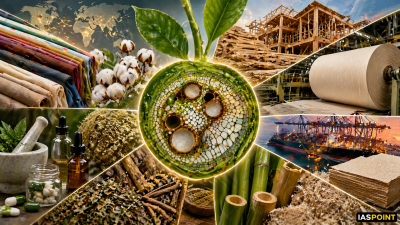
The economic utility of plant tissues bridges the gap between Core Biology and Economic Geography. Plant tissues are not just biological units but are the primary raw materials for the global textile, construction, pharmaceutical, and paper industries.
1. Sclerenchyma: The Backbone of the Fibre Industry
Sclerenchyma fibres are the most commercially exploited plant tissues due to their high tensile strength and lignified cell walls.
- Phloem/Bast Fibres: These are obtained from the “inner bark” or phloem of certain dicot plants.
- Jute (Corchorus): Derived from the secondary phloem. Used for gunny bags and twine.
- Flax (Linum): Used to produce high-quality linen fabric.
- Hemp (Cannabis sativa): Utilized for ropes, sails, and canvas.
- Surface Fibres: These are epidermal outgrowths.
- Cotton: These are actually unicellular hairs (trichomes) from the seed coat of Gossypium.
- Coir: Obtained from the fibrous mesocarp (sclerenchyma) of the coconut husk.
2. Xylem: The Timber and Paper Industry
The secondary xylem of perennial plants, commonly known as wood, is the pillar of the construction and fuel industries.
- Softwood vs. Hardwood: * Softwood: Derived from Gymnosperms (e.g., Pine, Cedar). It lacks vessels and is primarily composed of tracheids. Used for paper pulp and plywood.
- Hardwood: Derived from Angiosperm dicots (e.g., Teak, Oak). It contains vessels and high lignin content, providing durability for furniture.
- Pulp and Paper: The tracheids and xylem fibres are chemically or mechanically separated to create cellulose pulp, the base for all paper products.
- Tannins and Resins: Extracted from the heartwood (non-functional xylem), these are used in the leather tanning industry and for making varnishes and adhesives.
3. Protective Tissues: Cork and Bark
The secondary protective tissues, specifically the periderm, have specialized industrial applications.
- Quercus suber (Cork Oak): The thick cork (phellem) layer of this tree is harvested every 9–12 years. Because it contains Suberin, it is waterproof, buoyant, and elastic.
- Applications: Bottle stoppers, insulation boards, floor tiles, and the core of cricket balls.
- Medicinal Bark:
- Quinine: Extracted from the bark of the Cinchona tree (contains alkaloids in the phloem and parenchyma). It is the primary treatment for Malaria.
- Cinnamon: The dried inner bark (phloem/cambium layer) of Cinnamomum verum is a globally traded spice.
4. Secretory Tissues: Latex and Essential Oils
The “Special Tissues” of plants produce secondary metabolites that are indispensable to modern industry.
| Product | Tissue Source | Industrial Use |
| Natural Rubber | Laticiferous Vessels (Hevea) | Tyres, surgical gloves, and elastic components. |
| Opium Alkaloids | Laticifers (Papaver) | Morphine and Codeine for the pharmaceutical industry. |
| Turpentine/Rosins | Resin Ducts (Pinus) | Solvent for paints and chemical synthesis. |
| Essential Oils | Glandular Trichomes | Perfumery, food flavoring, and cosmetics. |
| Chicle | Laticifers (Manilkara) | The original base for chewing gum. |
5. Meristems and Plant Tissue Culture (PTC)
While not a direct product, the properties of meristematic tissues are the foundation of the modern Biotechnology and Agri-tech sectors.
- Micropropagation: Because meristematic cells are rapidly dividing and often virus-free (especially the shoot apex), they are used in labs to produce thousands of identical, disease-free clones of high-yield crops (e.g., Banana, Cardamom).
- Callus Formation: Permanent tissues are made to revert to a meristematic state (dedifferentiation) to create a “callus,” which is then used to engineer Genetically Modified (GM) crops like Bt Cotton.
UPSC Prelims Facts and Trivia
- Rayon: Often called “Artificial Silk,” it is produced by chemically treating the cellulose extracted from plant tissues (xylem/pulp).
- Amber: This precious gemstone is actually the fossilized resin secreted by ancient coniferous trees through their resin ducts.
- Bast Fibre Identification: In the textile industry, the presence of lignin helps distinguish natural bast fibres (like Jute) from synthetic ones under microscopic examination.
- Gutta-percha: A non-elastic latex from the Palaquium tree, historically used for insulating underwater telegraph cables because it is an excellent bio-insulator.