

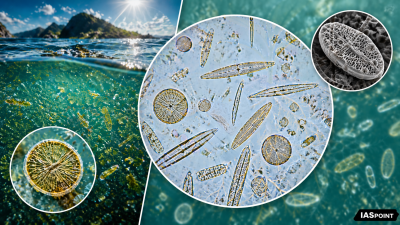
Diatoms are a major group of unicellular algae and are among the most common types of phytoplankton. They belong to the kingdom Protista (specifically the group Chrysophytes) and are characterized by their unique siliceous cell walls.
Structural Characteristics and “Diatomaceous Earth”
The most defining feature of diatoms is their cell wall, which is impregnated with silica (SiO2).
- Frustules: The cell walls form two thin overlapping shells, which fit together like a soap box. These walls are indestructible due to the presence of silica.
- Diatomaceous Earth: Over millions of years, the accumulation of these cell wall deposits at the bottom of oceans and lakes forms “Diatomaceous Earth” (or Kieselguhr). This gritty soil is harvested for various industrial uses.
Ecological Importance
Diatoms are often referred to as the “jewels of the sea” and the “pastures of the ocean” due to their immense ecological value.
- Primary Producers: They are the chief producers in the oceans, responsible for approximately 20% to 25% of all organic carbon fixation on the planet.
- Oxygen Production: Through photosynthesis, diatoms generate a significant portion of the Earth’s oxygen supply.
- Foundational Food Source: They form the base of the marine food chain, supporting a vast array of aquatic life from tiny zooplankton to large whales.
Economic and Industrial Applications
The physical and chemical properties of Diatomaceous Earth make it highly valuable in commerce.
- Filtration: Due to its porous nature and high surface area, it is used in the filtration of oils, syrups, sugars, and even in water purification systems.
- Polishing and Abrasives: The gritty texture makes it an ideal ingredient in toothpastes and metal polishes.
- Insulation: It is used as a thermal insulator in boilers and steam pipes because it is resistant to high temperatures.
- Pest Control: In its powdered form, it acts as a mechanical insecticide; the sharp silica particles dehydrate insects by damaging their exoskeletons.
Biological Classification and Trivia for UPSC
- Kingdom: Protista
- Group: Chrysophytes (which also includes Golden Algae/Desmids).
- Movement: Most diatoms lack flagella and float passively in water currents (planktonic).
- Bio-indicators: Diatoms are highly sensitive to changes in water quality (pH, salinity, and nutrient levels), making them excellent bio-indicators for monitoring environmental health and climate change.
- Forensic Science: “Diatom testing” is used in forensics to determine if a death was due to drowning, as the specific species of diatoms found in the victim’s lungs can be matched to the water body where they were found.
Comparison: Diatoms vs. Other Chrysophytes
| Feature | Diatoms | Golden Algae (Desmids) |
| Cell Wall | Siliceous (Silica-based), soap-box structure | Cellulosic, often highly symmetrical |
| Environment | Fresh and Marine water | Mostly Fresh water |
| Role | Chief Producers in oceans | Component of phytoplankton |
| Economic Use | Diatomaceous Earth (Filtration/Polishing) | Indicators of water purity |