

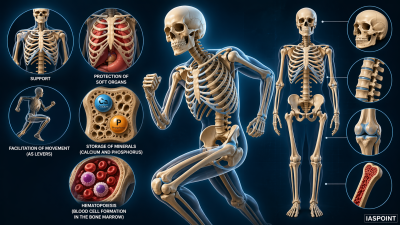
The human skeletal system is the internal framework of the body, composed of bones, cartilages, and ligaments. In an adult human, the system consists of 206 bones. It serves five primary functions: support, protection of soft organs, facilitation of movement (as levers), storage of minerals (Calcium and Phosphorus), and Hematopoiesis (blood cell formation in the bone marrow).
Division of the Skeletal System
The human skeleton is divided into two main sections based on the longitudinal axis of the body.
Axial Skeleton (80 Bones)
The axial skeleton constitutes the central core of the body and protects the vital organs of the head, neck, and trunk.
- Skull (29 bones): Includes the Cranium (8), Face (14), Auditory Ossicles (6), and the Hyoid bone (1).
- Vertebral Column (26 bones): A curved, flexible structure consisting of:
- Cervical vertebrae (7) – Neck region.
- Thoracic vertebrae (12) – Mid-back, attached to ribs.
- Lumbar vertebrae (5) – Lower back.
- Sacrum (1) – Five fused vertebrae.
- Coccyx (1) – Four fused vertebrae (tailbone).
- Thoracic Cage (25 bones): Comprised of the Sternum (breastbone) and 12 pairs of Ribs.
- True Ribs (1-7): Attached directly to the sternum.
- False Ribs (8-10): Attached indirectly via cartilage.
- Floating Ribs (11-12): No anterior attachment.
Appendicular Skeleton (126 Bones)
The appendicular skeleton includes the bones of the limbs and the girdles that attach them to the axial skeleton.
- Pectoral Girdle (4 bones): Clavicle (Collar bone) and Scapula (Shoulder blade).
- Upper Limbs (60 bones): Humerus (arm), Radius and Ulna (forearm), Carpals (8 wrist bones), Metacarpals (5 palm bones), and Phalanges (14 finger bones).
- Pelvic Girdle (2 bones): Formed by two Hip bones (Coxal bones).
- Lower Limbs (60 bones): Femur (thigh – longest bone), Tibia and Fibula (leg), Patella (kneecap), Tarsals (7 ankle bones), Metatarsals (5 foot bones), and Phalanges (14 toe bones).
Chemical and Cellular Composition
Bone is a living tissue with a unique matrix that allows it to be both hard and flexible.
| Component | Detail |
| Inorganic Matrix | 65% of bone mass; primarily Hydroxyapatite (Calcium Phosphate). Provides hardness. |
| Organic Matrix | 35% of bone mass; primarily Collagen fibers. Provides flexibility and tensile strength. |
| Osteoblasts | Bone-forming cells; they repair and build new bone tissue. |
| Osteoclasts | Bone-resorbing cells; they break down bone to release minerals into the blood. |
| Osteocytes | Mature bone cells that maintain the healthy bone matrix. |
Bone Marrow and Hematopoiesis
Bone marrow is the soft tissue found in the hollow interior of bones.
- Red Bone Marrow: Found in the spongy bone of the epiphyses and flat bones (sternum, pelvis). It is the site of Hematopoiesis (production of RBCs, WBCs, and platelets).
- Yellow Bone Marrow: Found in the medullary cavity of long bones. It consists mainly of fat cells and serves as energy storage.
Vital Prelims Facts and Trivia
- Smallest Bone: The Stapes in the middle ear.
- Longest Bone: The Femur (thigh bone).
- Only Floating Bone: The Hyoid bone in the throat is the only bone not in contact with any other bone.
- Bone Count Change: Infants are born with approximately 270-300 bones, many of which fuse together (like the skull and sacrum) as they grow into adults with 206 bones.
- Kneecap: The Patella is a sesamoid bone, meaning it develops inside a tendon.
- Hardest Substance: While bone is very hard, Tooth Enamel is the hardest substance in the human body.
Comparison of Bone and Cartilage
| Feature | Bone | Cartilage |
| Vascularity | Highly Vascular (Rich blood supply). | Avascular (No blood supply). |
| Matrix | Hardened by Calcium salts. | Flexible, made of Chondroitin salts. |
| Growth | Only Appositional (on the surface). | Appositional and Interstitial (from within). |
| Nerves | Present. | Absent. |
Common Pathologies
- Osteoporosis: A condition where bones become weak and brittle due to loss of bone density, often linked to Calcium or Vitamin D deficiency and hormonal changes.
- Osteomalacia: Softening of bones in adults due to Vitamin D deficiency (called Rickets in children).
- Paget’s Disease: A disorder of bone remodeling that results in enlarged and misshapen bones.