

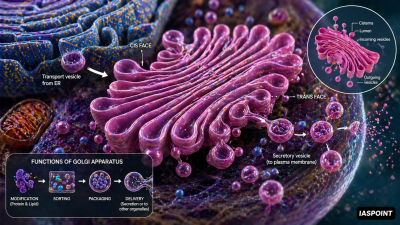
The Golgi Apparatus (also known as the Golgi Complex or Golgi Body) is a central membrane-bound organelle found in most eukaryotic cells. Discovered by Italian biologist Camillo Golgi in 1898 using a silver staining technique, it functions as the “Post Office” or “Shipping and Receiving Department” of the cell. It is responsible for modifying, sorting, and packaging proteins and lipids for secretion or delivery to other organelles.
Structural Organization
The Golgi apparatus consists of a series of flattened, stacked pouches called cisternae. A typical Golgi stack contains four to eight cisternae, though some protists may have up to sixty.
- Polarity: The organelle exhibits distinct structural and functional polarity, divided into two faces:
- Cis Face (Forming Face): Usually located near the Endoplasmic Reticulum (ER). It receives transport vesicles containing newly synthesized proteins from the ER.
- Trans Face (Maturing Face): Oriented toward the plasma membrane. It acts as the exit point where vesicles bud off to reach their final destinations.
- Dictyosomes: In plant cells, the Golgi bodies are often referred to as dictyosomes. They are more scattered and less interconnected than those found in animal cells.
Primary Functions of the Golgi Apparatus
1. Modification of Proteins and Lipids
The Golgi is the primary site for the biochemical “fine-tuning” of macromolecules.
- Glycosylation: It modifies the carbohydrate chains of glycoproteins initially added in the ER.
- Phosphorylation: It adds phosphate groups to molecules (e.g., tagging lysosomal enzymes with Mannose-6-phosphate so they are routed correctly).
- Sulfation: Addition of sulfate groups to certain protein molecules.
2. Sorting and Packaging
The Golgi acts as a dispatch station. Proteins are “tagged” with specific chemical groups that act as molecular addresses, ensuring they reach the plasma membrane, lysosomes, or are secreted outside the cell.
3. Synthesis of Polysaccharides
In plant cells, the Golgi apparatus is responsible for synthesizing complex polysaccharides, such as pectin and hemicellulose, which are essential components of the cell wall.
4. Formation of Lysosomes
The Golgi apparatus is directly involved in the production of primary lysosomes. It packages hydrolytic enzymes into specialized vesicles that remain within the cytoplasm.
Functional Comparison: Golgi vs. Endoplasmic Reticulum
| Feature | Endoplasmic Reticulum (ER) | Golgi Apparatus |
| Origin | Originates from the nuclear membrane | Originates from the vesicles of the ER |
| Primary Role | Manufacturing (Proteins/Lipids) | Processing and Packaging |
| Connection | Physically connected to the nucleus | Isolated organelle (uses vesicle transport) |
| Components | Cisternae and Tubules | Cisternae and Vesicles |
Essential Facts for UPSC Prelims
The Secretory Pathway
The flow of materials generally follows this sequence: Nucleus → Rough ER → Transport Vesicle → Golgi (Cis to Trans) → Secretory Vesicle → Plasma Membrane. This is a frequent theme in cellular biology questions regarding the “Endomembrane System.”
Acrosome Formation
A specialized function of the Golgi apparatus in male reproductive biology is the formation of the acrosome in sperm cells. The acrosome is a cap-like structure filled with enzymes that help the sperm penetrate the egg’s outer coat.
Presence and Absence
- Present: In all eukaryotic cells (Animal, Plant, Fungi).
- Absent: In prokaryotes (Bacteria) and certain specialized eukaryotic cells like mature mammalian Red Blood Cells (RBCs) and sieve tubes in plants.
Trivia and Key Concepts
- Traffic Police of the Cell: A common metaphorical name for the Golgi due to its role in directing macromolecule flow.
- Camillo Golgi’s Nobel Prize: He shared the Nobel Prize in Physiology or Medicine in 1906 with Santiago Ramón y Cajal, primarily for his work on the structure of the nervous system, which led to the discovery of this organelle.
- Vesicle Budding: The process by which pieces of the Golgi membrane pinch off to transport materials is energy-dependent and involves coat proteins like COPI and COPII.