

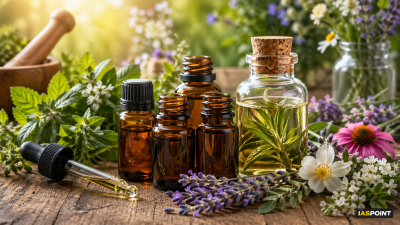
Essential oils are volatile, aromatic organic compounds secreted by plants as secondary metabolites. Botanically, they serve as a defense mechanism against herbivores, attractants for pollinators, or as antifungal/antibacterial agents. Chemically, they are complex mixtures of Terpenoids and Phenylpropanoids. Unlike “fixed oils” (like Mustard or Groundnut oil), essential oils evaporate at room temperature and do not leave a translucent stain on paper.
Classification based on Plant Parts
Essential oils can be stored in various specialized structures such as glandular trichomes, oil ducts, or lysigenous cavities.
Floral Essential Oils
- Rosa damascena (Rose Oil): Extracted via steam distillation of petals. The byproduct is “Rose Water.” It contains Geraniol and Citronellol.
- Jasminum officinale (Jasmine Oil): Primarily extracted through Enfleurage (using fat) because the aromatic compounds are delicate.
- Lavandula angustifolia (Lavender Oil): Known for its calming properties and use in aromatherapy.
Leaf and Stem Essential Oils
- Cymbopogon citratus (Lemongrass Oil): Rich in Citral. Used in perfumery and as a flavoring agent.
- Cymbopogon nardus (Citronella Oil): Widely used as a natural insect repellent.
- Eucalyptus globulus (Eucalyptus Oil): Derived from the leaves. The active component is Eucalyptol (Cineole), used in medicines for respiratory relief.
- Mentha arvensis (Menthol/Peppermint Oil): Contains Menthol, providing a cooling sensation by triggering cold-sensitive receptors in the skin.
Grass-based Essential Oils (Poaceae Family)
- Vetiveria zizanioides (Khus Oil): Uniquely extracted from the roots of the grass. It is a fixative in high-end perfumes due to its low volatility.
- Cymbopogon martini (Palmarosa Oil): High Geraniol content, often used to adulterate rose oil.
Wood and Bark Essential Oils
- Santalum album (Sandalwood Oil): Extracted from the heartwood. The main components are alpha and beta-santalols.
- Cedrus deodara (Cedarwood Oil): Obtained from the wood of the Deodar tree; used as an incense and insect repellent.
Extraction Methods in Economic Botany
- Steam Distillation: The most common method where steam passes through the plant material, carrying the volatile oils.
- Solvent Extraction: Used for flowers that cannot withstand the heat of steam (e.g., Jasmine).
- Expression (Cold Pressing): Primarily used for Citrus oils (Orange, Lemon) where the oil glands in the rind are mechanically ruptured.
- Enfleurage: An ancient method using odorless fats to absorb the fragrance of flower petals.
Summary Table of Essential Oils
| Source Plant | Botanical Name | Part Used | Key Component |
| Sandalwood | Santalum album | Heartwood | Santalol |
| Lemongrass | Cymbopogon citratus | Leaves | Citral |
| Clove | Syzygium aromaticum | Flower Bud | Eugenol |
| Peppermint | Mentha arvensis | Leaves/Flowering tops | Menthol |
| Khus | Vetiveria zizanioides | Roots | Vetiverol |
| Eucalyptus | Eucalyptus globulus | Leaves | Eucalyptol |
UPSC Prelims: Essential Facts and Trivia
- Terpenes: These are the primary building blocks of most essential oils, composed of Isoprene units (C5H8).
- Fixatives: Some essential oils with high boiling points (like Sandalwood or Vetiver) are used as fixatives to slow down the evaporation of more volatile scents in perfumes.
- Glandular Trichomes: In many aromatic plants like Mint and Basil, the essential oil is stored in tiny hair-like structures on the leaf surface called trichomes.
- Phytochemical Defense: Many essential oils (like those in Garlic or Neem) are toxic to insects, acting as natural “biopesticides.”
- Economic Impact: India is a global leader in the production of Mentha oil, largely concentrated in the Indo-Gangetic plains (Uttar Pradesh).
- Aroma Mission: The Government of India launched the CSIR-Aroma Mission to promote the cultivation of aromatic crops like Lavender, Rosemary, and Lemongrass to boost the income of farmers in hilly and semi-arid regions.