

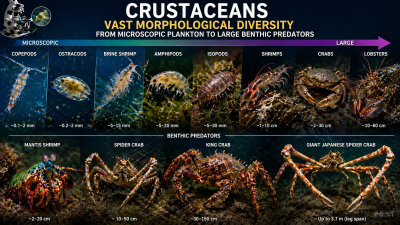
Crustaceans exhibit vast morphological diversity, ranging from microscopic plankton to large benthic predators.
Decapods: The Ten-Footed Crustaceans
The order Decapoda contains the most commercially and ecologically significant crustaceans. They are characterized by having five pairs of thoracic legs.
- Prawns and Shrimps: Primarily swimming crustaceans with laterally compressed bodies and long antennae.
- Biological Fact: They possess well-developed pleopods (swimmerets) used for locomotion and carrying eggs.
- Crabs (Brachyura): Characterized by a reduced abdomen tucked entirely under the cephalothorax.
- Example: The Fiddler Crab is known for its sexual dimorphism, where males possess one oversized claw for signaling and combat.
- Lobsters: Large, heavy-bodied bottom dwellers.
- Example: The Spiny Lobster lacks the large pinching claws (chelae) found in True Lobsters but possesses thick, oversized antennae for defense.
Branchiopods: The “Gill-Footed” Crustaceans
These are primitive crustaceans found mostly in freshwater. Their appendages act as both gills and feeding organs.
- Daphnia (Water Fleas): Transparent, microscopic organisms crucial for aquatic food webs.
- Significance: They serve as a standard model organism in environmental toxicology to test water purity.
- Artemia (Brine Shrimp): Found in hypersaline lakes (e.g., Sambhar Lake in Rajasthan).
- Trivia: Their eggs (cysts) can remain dormant for years in a state of cryptobiosis until conditions improve.
Maxillopods: Diverse and Specialized Forms
This class includes both highly mobile plankton and stationary (sessile) adults.
- Barnacles: Unique because the adults are sessile, attaching themselves permanently to hard surfaces like rocks or whale skin.
- Anatomy: They are encased in calcareous plates and use feathery “cirri” to filter feed from the water.
- Copepods: Small, teardrop-shaped crustaceans that are perhaps the most numerous multicellular animals in the aquatic environment.
- Role: They represent the primary link between phytoplankton (producers) and higher trophic levels (consumers).
Isopods: The Terrestrial Exception
While 99% of crustaceans are aquatic, one specific group has successfully transitioned to land.
- Woodlice (Sowbugs/Pillbugs): Commonly found in damp soil and under logs.
- Adaptation: They have “pseudotracheae” on their hind legs that must remain moist to facilitate gas exchange. This is a classic example of incomplete terrestrial adaptation within Arthropoda.
Comparative Table of Key Examples
| Common Name | Taxonomic Group | Habitat | Distinctive Feature |
| Krill | Euphausiacea | Marine (Open Ocean) | Primary diet of baleen whales; bioluminescent organs. |
| Hermit Crab | Anomura | Marine (Coastal) | Lacks a hard abdominal shell; occupies discarded gastropod shells. |
| Cyclops | Copepoda | Freshwater | Possesses a single median eye at the front of the head. |
| Triops | Branchiopoda | Temporary Pools | Known as “living fossils” as their morphology has remained unchanged for millions of years. |
Evolutionary and Ecological Trivia
- Living Fossils: Triops cancriformis is often cited in evolutionary biology as one of the oldest living species, with fossil records dating back to the Triassic period.
- The “Cleaner” Relationship: Species like the Cleaner Shrimp engage in mutualism by removing parasites from the mouths and bodies of reef fish.
- Parasitic Crustaceans: Not all crustaceans are free-living. The Cymothoa exigua (Tongue-eating louse) is a parasitic isopod that replaces a fish’s tongue, acting as a functional replacement while consuming the host’s nutrients.