

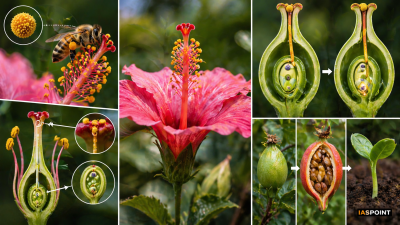
Sexual reproduction in plants involves the fusion of male and female gametes to produce a genetically diverse zygote. In Angiosperms (flowering plants), the flower serves as the specialized reproductive unit. This process ensures genetic variation, which is critical for evolution and adaptation.
The Structure of a Flower
A typical flower consists of four whorls arranged on a swollen stalk called the thalamus or receptacle.
Non-Essential Whorls (Accessory Organs)
- Calyx (Sepals): The outermost green, leaf-like structures that protect the flower in the bud stage.
- Corolla (Petals): Brightly colored structures designed to attract pollinators (insects, birds).
Essential Whorls (Reproductive Organs)
- Androecium (Male): Composed of stamens. Each stamen consists of a filament and an anther. The anther produces pollen grains (microspores).
- Gynoecium (Female): Composed of carpels or pistils. A pistil consists of three parts:
- Stigma: The receptive landing platform for pollen.
- Style: The elongated tube connecting the stigma to the ovary.
- Ovary: The basal swollen part containing ovules.
Key Processes in Sexual Reproduction
1. Pollination
The transfer of pollen grains from the anther to the stigma.
- Autogamy (Self-pollination): Transfer within the same flower.
- Geitonogamy: Transfer between flowers of the same plant (genetically similar to self-pollination).
- Xenogamy (Cross-pollination): Transfer between flowers of different plants. This introduces genetic variability.
2. Pollen-Pistil Interaction and Fertilization
Once a compatible pollen grain lands on the stigma, it germinates to produce a pollen tube that grows through the style to reach the ovary.
- Syngamy: One male gamete fuses with the egg cell to form a Zygote (2n).
- Triple Fusion: The second male gamete fuses with two polar nuclei to form the Primary Endosperm Nucleus (PEN) (3n).
- Double Fertilization: The unique phenomenon in Angiosperms involving both Syngamy and Triple Fusion.
Post-Fertilization Changes
After fertilization, the flower undergoes significant transformations to ensure the development of the next generation.
| Floral Part | Post-Fertilization Transformation |
| Zygote | Embryo (Future Plant) |
| Ovule | Seed |
| Ovary | Fruit |
| Ovary Wall | Pericarp (Fruit Wall) |
| PEN (3n) | Endosperm (Nutritive tissue for embryo) |
| Integuments | Seed Coat (Testa and Tegmen) |
Types of Fruits
- True Fruits: Develop only from the ovary (e.g., Mango, Tomato).
- False Fruits: Other floral parts, like the thalamus, contribute to fruit formation (e.g., Apple, Strawberry, Cashew).
- Parthenocarpic Fruits: Fruits developed without fertilization; these are naturally seedless (e.g., Banana).
Important UPSC Prelims Terminologies
- Dichogamy: A mechanism to prevent self-pollination where the anther and stigma mature at different times.
- Cleistogamous Flowers: Flowers that never open (e.g., Commelina), ensuring self-pollination even in the absence of pollinators.
- Anemophily: Pollination by wind (common in grasses; pollen is light and non-sticky).
- Hydrophily: Pollination by water (e.g., Vallisneria, Hydrilla).
- Entomophily: Pollination by insects (most common biotic agent).
Comparison: Monocots vs. Dicots Seeds
- Dicot Seeds: Possess two cotyledons. Food is often stored in cotyledons (e.g., Pea, Gram).
- Monocot Seeds: Possess a single cotyledon (Scutellum). Large endosperm is usually present for food storage (e.g., Maize, Wheat).
Significance of Sexual Reproduction
- Genetic Recombination: Leads to new combinations of traits.
- Dormancy: Seeds can undergo a period of suspended animation, allowing plants to survive unfavorable environmental conditions and disperse across geographic distances.