

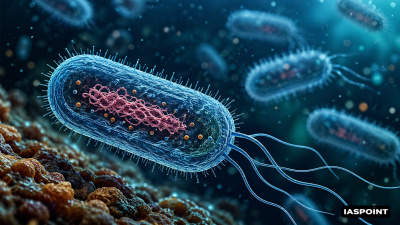
Bacteria are unicellular prokaryotic organisms belonging to the Kingdom Monera. Unlike eukaryotic cells, they lack a membrane-bound nucleus and specialized organelles like mitochondria or chloroplasts. Their structure is optimized for rapid growth and survival in diverse environments, ranging from hydrothermal vents to the human gut.
The Protective Envelope
The bacterial cell is encased in a complex, multi-layered envelope that provides structural integrity and protection.
1. Glycocalyx (Capsule or Slime Layer)
- Capsule: A thick, organized, and tough outer layer that protects the bacteria from host immune systems (phagocytosis).
- Slime Layer: A loose, unorganized layer that helps in adhesion to surfaces and prevents dehydration.
2. Cell Wall
- Composition: Primarily made of Peptidoglycan (murein), a polymer of sugars and amino acids.
- Function: Provides shape and prevents the cell from bursting in hypotonic environments.
- Classification: It is the basis for Gram Staining. Gram-positive bacteria have a thick peptidoglycan layer, while Gram-negative bacteria have a thin layer and an outer lipid membrane.
3. Plasma Membrane
- Nature: A semi-permeable phospholipid bilayer.
- Mesosomes: Unique inward foldings of the plasma membrane. They assist in cell wall formation, DNA replication, and respiration (acting as a functional equivalent to mitochondria).
Cytoplasmic Components
The interior of the bacterial cell is a dense, granular matrix containing the machinery for life.
- Nucleoid: Since there is no nuclear membrane, the genetic material (a single, circular, double-stranded DNA molecule) is located in an irregular region called the nucleoid.
- Plasmids: Small, circular, extrachromosomal DNA molecules. They often carry genes for Antibiotic Resistance and are widely used in biotechnology as vectors.
- Ribosomes: Bacteria possess 70S ribosomes (composed of 50S and 30S subunits). These are the sites of protein synthesis.
- Inclusion Bodies: Reserve materials stored in the cytoplasm, such as phosphate granules, cyanophycean granules, and glycogen granules.
Surface Appendages
These structures extend from the cell surface and are involved in motility and interaction.
- Flagella: Long, hair-like structures used for locomotion. A bacterium can be monotrichous (one flagellum), lophotrichous (clump at one end), or peritrichous (all over).
- Pili (Fimbriae): * Pili: Longer structures used in Conjugation (transfer of DNA between bacteria).
- Fimbriae: Bristle-like fibers that help bacteria attach to rocks in streams or host tissues.
Comparison: Gram-Positive vs. Gram-Negative Bacteria
| Feature | Gram-Positive | Gram-Negative |
| Peptidoglycan Layer | Thick (multi-layered) | Thin (single-layered) |
| Outer Membrane | Absent | Present (contains Lipopolysaccharides) |
| Toxins Produced | Mostly Exotoxins | Mostly Endotoxins |
| Antibiotic Sensitivity | Generally more susceptible | Generally more resistant |
| Gram Stain Color | Purple / Violet | Red / Pink |
Essential Trivia for UPSC Prelims
- Mycoplasma: The smallest known living cells. They are unique because they lack a cell wall and can survive without oxygen. They are highly resistant to antibiotics like penicillin that target cell wall synthesis.
- Binary Fission: The primary mode of bacterial reproduction. Under ideal conditions, bacteria like E. coli can double every 20 minutes.
- Endospores: Some bacteria (e.g., Bacillus and Clostridium) produce highly resistant, dormant structures called endospores to survive extreme heat, radiation, and chemical disinfectants.
- Genomic DNA vs. Plasmid: While the genomic DNA (nucleoid) is essential for survival and reproduction, plasmids provide “bonus” traits like resistance to heavy metals or antibiotics.