

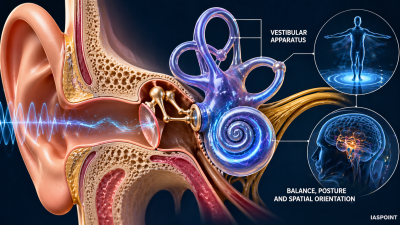
The inner ear is not only responsible for hearing but also serves as the body’s primary sensory system for maintaining balance and posture. This function is carried out by the Vestibular Apparatus, located above the cochlea in the inner ear.
1. Components of the Vestibular Apparatus
The vestibular apparatus consists of two main structures, both filled with endolymph (a potassium-rich fluid) and lined with specialized hair cells.
- Semicircular Canals: There are three canals positioned at right angles to each other (orthogonal) to cover the three planes of space: horizontal, vertical, and sagittal.
- Otolith Organs: These consist of the Saccule and the Utricle. They contain a sensory patch called the Macula.
2. Mechanism of Dynamic Equilibrium (Semicircular Canals)
Dynamic equilibrium refers to the detection of rotational or angular movements of the head (e.g., turning the head, spinning, or somersaulting).
- Crista Ampullaris: Each semicircular canal has a swollen base called the Ampulla, which contains a sensory ridge known as the Crista.
- The Cupula: The hair cells of the crista are embedded in a gelatinous mass called the Cupula.
- The Process: When the head rotates, the endolymph fluid inside the canals moves due to inertia. This movement bends the cupula and the hair cells, triggering nerve impulses.
3. Mechanism of Static Equilibrium (Otolith Organs)
Static equilibrium refers to the detection of the head’s position relative to gravity and linear acceleration (e.g., moving in an elevator or a car).
- The Macula: The sensory epithelium found in both the saccule and utricle.
- Otoliths (Statoconia): The macula is covered by a gelatinous membrane embedded with small crystals of calcium carbonate called Otoliths or “ear stones.”
- The Process: When the head tilts or moves linearly, gravity pulls on the heavy otoliths. This shift bends the hair cells in the macula, signaling the brain about the body’s orientation.
Comparison: Hearing vs. Balance
| Feature | Hearing (Cochlea) | Balance (Vestibular Apparatus) |
| Receptor Organ | Organ of Corti | Crista and Macula |
| Stimulus | Sound waves | Gravity and Rotation |
| Fluid Involved | Perilymph and Endolymph | Endolymph |
| Cranial Nerve | Cochlear branch of VIII nerve | Vestibular branch of VIII nerve |
4. Neural Pathway and Integration
- Generation: Bending of hair cells in the Cristae or Maculae generates an electrical signal.
- Transmission: The signal travels via the Vestibular Nerve (part of the VIII Cranial Nerve).
- Coordination: The impulses are sent to the Cerebellum (the part of the brain responsible for motor coordination) and the brainstem.
- Action: The brain integrates this with visual input and data from muscle receptors (Proprioceptors) to adjust posture and eye movements.
Key Facts for UPSC Prelims
- Vertigo: A sensation of spinning or loss of balance, often caused by the displacement of otoliths into the semicircular canals or inflammation of the inner ear.
- Motion Sickness: Occurs when there is a conflict between sensory inputs; for example, the vestibular system feels motion in a ship’s cabin, but the eyes see a stationary environment.
- Proprioception: While the ear handles balance, “Proprioception” is the “sixth sense” located in muscles and joints that tells the brain where body parts are without looking at them.
- Cerebellum Link: The cerebellum is the chief administrator of balance. Alcohol affects the cerebellum, which is why intoxicated individuals lose their sense of equilibrium.