

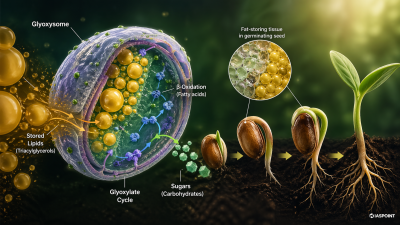
Glyoxysomes are specialized peroxisomes found primarily in plants and filamentous fungi. They are most prominent in the fat-storing tissues of germinating seeds. Their primary biological significance lies in their ability to convert stored lipids into carbohydrates, a process essential for seedling growth before the onset of photosynthesis.
Structure and Occurrence
- Membrane: Like peroxisomes, they are bound by a single lipid bilayer membrane.
- Location: Found in the endosperm or cotyledons of oil-seed plants such as castor, groundnut, and sunflower.
- Temporal Presence: They are temporary organelles, appearing during seed germination and usually disappearing or transforming into regular peroxisomes once the seedling begins photosynthesis.
The Glyoxylate Cycle: Mechanism and Enzymes
The distinguishing feature of glyoxysomes is the Glyoxylate Cycle, which is a variation of the TCA (Krebs) cycle. This pathway allows the bypass of CO2-releasing steps, ensuring carbon atoms from fatty acids are conserved for glucose synthesis.
Key Enzymes
Glyoxysomes contain the two unique enzymes required for this cycle:
- Isocitrate Lyase: Cleaves isocitrate into succinate and glyoxylate.
- Malate Synthase: Combines glyoxylate with acetyl-CoA to form malate.
Metabolic Pathway
- Beta-Oxidation: Fatty acids are broken down into Acetyl-CoA within the glyoxysome.
- Cycle Initiation: Acetyl-CoA enters the glyoxylate cycle to produce succinate.
- Gluconeogenesis: Succinate is exported to the mitochondria and subsequently converted into glucose in the cytosol.
Comparison: Glyoxysomes vs. Standard Peroxisomes
| Feature | Glyoxysome | Standard Peroxisome |
| Occurrence | Primarily germinating oil seeds | Ubiquitous in eukaryotes (Liver/Kidney in humans) |
| Unique Pathway | Glyoxylate Cycle | Photorespiration / H2O2 degradation |
| Major Product | Carbohydrates (Succinate/Glucose) | Water and Oxygen (via Catalase) |
| Function | Fat-to-Carbohydrate conversion | Detoxification and Photorespiration |
Importance in Plant Physiology
- Seed Germination: Seeds are often rich in fats (triacylglycerols) because fats provide more energy per gram than starch. Glyoxysomes enable the seedling to tap into this dense energy reserve to build cell walls and structural components (cellulose/sugars) during initial growth.
- Carbon Conservation: By bypassing the decarboxylation steps of the Citric Acid Cycle, glyoxysomes prevent the loss of carbon as CO2, making the conversion of fat to sugar highly efficient.
Facts for UPSC Prelims
- Absence in Animals: Animals lack the enzymes (Isocitrate lyase and Malate synthase) of the glyoxylate cycle. Therefore, animals cannot convert fatty acids into glucose; they can only convert fats into energy (ATP) or CO2.
- Inter-organelle Cooperation: The conversion of fats to sugars is a collaborative effort involving three organelles: Glyoxysomes, Mitochondria, and Cytosol.
- Discovery: The glyoxylate cycle was elucidated by Hans Kornberg and Neil Tomlinson in the 1950s, highlighting the specialized role of these organelles in plant metabolism.
- Transition: As the seed develops green leaves and starts photosynthesis, glyoxysomes are replaced by leaf peroxisomes, which handle photorespiration.