

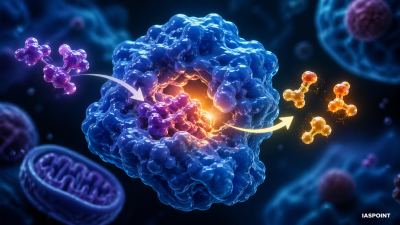
Enzymes are biological catalysts that significantly accelerate the rate of chemical reactions within living organisms without being consumed in the process. Almost all enzymes are proteins, though a small group of catalytic RNA molecules called Ribozymes also exists. They are essential for metabolism, as most biological reactions would occur too slowly to sustain life without them.
Chemical Nature and Structure
- Proteinaceous Nature: Most enzymes are globular proteins with a complex Tertiary Structure.
- Active Site: Every enzyme has a specific pocket or crevice called the “Active Site.” The substrate fits into this site, where the chemical reaction takes place.
- Apoenzyme and Holoenzyme: * Apoenzyme: The protein portion of the enzyme.
- Cofactor: A non-protein component required for activity (e.g., metal ions like Zn2+ or organic molecules like vitamins).
- Holoenzyme: The complete, catalytically active enzyme (Apoenzyme + Cofactor).
Mechanism of Enzyme Action
Enzymes work by lowering the Activation Energy (Ea) required for a reaction to proceed. This allows the transition state to be reached more easily at body temperature.
The Catalytic Cycle
- The substrate binds to the Active Site of the enzyme.
- The binding induces the enzyme to alter its shape, fitting more tightly around the substrate (Induced Fit Model).
- The enzyme-substrate (ES) complex is formed.
- Chemical bonds of the substrate are broken/formed, creating the enzyme-product (EP) complex.
- The product is released, and the free enzyme is ready to bind another substrate.
Factors Affecting Enzyme Activity
The activity of an enzyme is highly sensitive to its environment. Deviations from “optimum” conditions can lead to denaturation.
- Temperature: Most enzymes function optimally at body temperature (approx. 37°C in humans). Low temperatures preserve enzymes in a temporary inactive state, while high temperatures destroy them by denaturing the protein structure.
- pH: Each enzyme has an optimum pH (e.g., Pepsin in the stomach works at pH 2, while Salivary Amylase works at pH 6.8).
- Substrate Concentration: Initially, the rate of reaction increases with substrate concentration until all active sites are saturated (Vmax).
Enzyme Inhibition
Inhibition occurs when a molecule (inhibitor) binds to an enzyme and decreases its activity.
- Competitive Inhibition: The inhibitor closely resembles the substrate and competes for the active site.
- Example: Malonate competes with Succinate for the enzyme Succinic Dehydrogenase. This principle is used to treat bacterial infections (e.g., Sulfa drugs).
- Non-competitive Inhibition: The inhibitor binds to a different site (allosteric site), changing the enzyme’s shape so the substrate no longer fits.
- Feedback Inhibition: The end-product of a metabolic pathway inhibits an upstream enzyme to prevent overproduction.
Classification of Enzymes
The International Union of Biochemistry (IUB) classifies enzymes into six functional groups:
| Class | Function | Examples |
| Oxidoreductases | Catalyze oxidation-reduction reactions. | Dehydrogenases. |
| Transferases | Transfer a functional group (e.g., Methyl, Phosphate). | Kinases. |
| Hydrolases | Catalyze bond cleavage by adding water. | Digestive enzymes (Lipase, Amylase). |
| Lyases | Remove groups without hydrolysis, leaving double bonds. | Decarboxylases. |
| Isomerases | Catalyze structural rearrangements (isomers). | Phosphoglucoisomerase. |
| Ligases | Join two molecules together using ATP energy. | DNA Ligase. |
Important Enzymes and Their Roles
- Amylase: Breaks down starch into maltose (found in saliva and pancreatic juice).
- DNA Polymerase: Vital for DNA replication.
- RuBisCO: The most abundant enzyme on Earth, critical for CO2 fixation in plants.
- Carbonic Anhydrase: One of the fastest known enzymes; it facilitates the transport of CO2 in the blood by converting it to bicarbonate.
- Lysozyme: An antibacterial enzyme found in tears, saliva, and egg whites that destroys bacterial cell walls.
UPSC Prelims Fact File
- Pro-enzymes (Zymogens): These are inactive precursors of enzymes. For example, Pepsinogen is secreted in the stomach and must be converted to active Pepsin by Hydrochloric Acid (HCl).
- Turnover Number: The number of substrate molecules an enzyme can convert into product per unit of time. Carbonic anhydrase has one of the highest (approx. 600,000 per second).
- Enzyme Denaturation: Unlike inorganic catalysts, enzymes are sensitive to heat because they are made of proteins. Most are destroyed above 40–45°C.
- Co-enzymes: These are organic cofactors, often derived from vitamins. For example, NAD and NADP contain the vitamin Niacin (B3).