

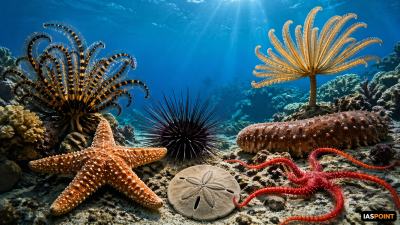
Echinodermata (from Greek echinos meaning “spiny” and derma meaning “skin”) is a phylum of exclusively marine organisms. They represent the most advanced group of non-chordate invertebrates and are deuterostomes, a feature they share with chordates.
Distinctive Features of Echinoderms
- Habitat: Strictly marine; no terrestrial or freshwater species exist.
- Symmetry: Adults exhibit pentamerous radial symmetry, while the larvae are bilaterally symmetrical. This evolutionary reversal is a key diagnostic feature for UPSC Prelims.
- Body Organization: Organ-system level of organization. They are triploblastic and coelomate.
- Endoskeleton: Composed of calcareous ossicles (calcium carbonate plates), giving them their “spiny-skinned” appearance.
The Water Vascular System (Ambulacral System)
The most unique feature of Echinodermata is the Water Vascular System, a modified part of the coelom. It serves several vital functions:
- Locomotion: Facilitated by tube feet (podia).
- Food Capture and Transport: Moves prey toward the mouth.
- Respiration: Exchange of gases occurs through the tube feet and dermal branchiae (skin gills).
- Excretion: Nitrogenous waste (primarily ammonia) diffuses out through the thin walls of the tube feet; they lack a specialized excretory organ.
Physiological Systems and Body Functions
Digestive System
The digestive system is usually complete with a mouth on the ventral (lower) side and an anus on the dorsal (upper) side. However, in brittle stars (Ophiuroidea), the digestive system is incomplete (lacks an anus).
Nervous and Sensory Systems
The nervous system is primitive, consisting of a nerve ring and radial nerves. They lack a centralized brain. Sensory organs like chemoreceptors and statocysts are present but simple.
Reproduction and Development
- Sexes: Usually separate (dioecious).
- Fertilization: Typically external, occurring in sea water.
- Development: Indirect, involving free-swimming, bilaterally symmetrical larvae.
- Regeneration: High power of regeneration; they can regrow lost arms or even internal organs (autotomy).
Classification and Key Examples
| Class | Common Name | Key Example | Unique Characteristic |
| Asteroidea | Starfish | Asterias | Arms not sharply marked off from the central disc. |
| Ophiuroidea | Brittle Star | Ophiura | Long, slender arms sharply demarcated from the disc. |
| Echinoidea | Sea Urchin | Echinus | Lacks arms; body is globular or discoid. |
| Holothuroidea | Sea Cucumber | Cucumaria | Body is elongated; lacks arms and spines. |
| Crinoidea | Sea Lily | Antedon | Plant-like appearance; mouth and anus on the same side. |
Evolutionary Significance and UPSC Trivia
- Deuterostome Affinity: Echinoderms are the only major invertebrate phylum that are deuterostomes (where the blastopore becomes the anus), making them more closely related to Chordates (humans) than to Annelids or Arthropods.
- Aristotle’s Lantern: This is a complex masticatory (chewing) apparatus found specifically in Sea Urchins (Echinus).
- Hemal System: Instead of a traditional circulatory system, they possess a hemal and perihemal system of unknown function, likely assisting in nutrient distribution.
- Ecological Role: Sea urchins are vital for controlling algal growth on coral reefs, while sea cucumbers play a major role in nutrient cycling on the ocean floor, often referred to as “earthworms of the sea.”
Comparison: Mollusca vs. Echinodermata
| Feature | Mollusca | Echinodermata |
| Symmetry | Bilateral (except Gastropods) | Radial (Adults), Bilateral (Larvae) |
| Habitat | Terrestrial, Marine, Freshwater | Exclusively Marine |
| Body Cavity | Reduced Coelom (Haemocoel) | True Coelom |
| Excretion | Organ of Bojanus / Keber’s Organ | Diffusion (No specific organ) |
| Skeleton | External Calcareous Shell | Internal Calcareous Ossicles |