

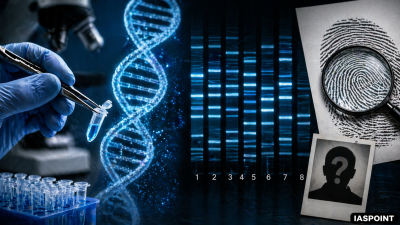
DNA Fingerprinting, also known as DNA Profiling or Genetic Fingerprinting, is a technique used to identify individuals by analyzing specific patterns in their DNA. While 99.9% of human DNA is identical across the species, the remaining 0.1% contains variations that are unique to every individual (except identical twins). Developed in 1984 by Sir Alec Jeffreys, this technology has become a cornerstone of forensic science, paternity testing, and biodiversity conservation.
The Scientific Basis: Junk DNA and Polymorphism
The technique does not focus on genes that code for proteins, but rather on non-coding sequences often called “Junk DNA.”
- Variable Number Tandem Repeats (VNTRs): These are short nucleotide sequences that are repeated multiple times in a row. The number of repeats varies significantly between individuals.
- Short Tandem Repeats (STRs): Similar to VNTRs but shorter (2–5 base pairs). STRs are currently the “gold standard” for forensic DNA typing because they are easier to amplify using PCR.
- DNA Polymorphism: This refers to the variations at the genetic level. These variations are inheritable and form the basis of genetic mapping and fingerprinting.
The Step-by-Step Process
- Extraction: DNA is isolated from biological samples like blood, hair follicles, saliva, or skin cells.
- Amplification: If the DNA sample is small, Polymerase Chain Reaction (PCR) is used to create millions of copies of specific DNA segments.
- Restriction Digestion: The DNA is cut into fragments at specific sites using Restriction Endonucleases (molecular scissors).
- Electrophoresis: Fragments are separated by size using an agarose gel. Smaller fragments move faster toward the positive electrode.
- Southern Blotting: The separated DNA fragments are transferred from the gel to a synthetic membrane (like nylon).
- Hybridization: Radioactive or fluorescent DNA Probes (complementary to VNTR sequences) are added to the membrane to bind with specific fragments.
- Autoradiography: A X-ray film is exposed to the membrane to reveal a unique pattern of dark bands—the DNA Fingerprint.
Applications of DNA Fingerprinting
| Field | Specific Application |
| Forensics | Identifying suspects or victims in criminal investigations by matching DNA from crime scenes. |
| Paternity/Maternity | Settling legal disputes regarding biological parenthood (child inherits 50% DNA from each parent). |
| Medical Research | Identifying genetic markers for hereditary diseases and potential organ transplant compatibility. |
| Conservation | Monitoring the genetic diversity of endangered species and tracking illegal poaching (e.g., Ivory trade). |
| Anthropology | Studying human migration patterns and evolutionary history. |
DNA Fingerprinting in the Indian Context
India is a leader in DNA technology research in South Asia, with established legal and institutional frameworks.
- CCMB (Centre for Cellular and Molecular Biology): Located in Hyderabad, it is the premier institute for DNA fingerprinting in India. Dr. Lalji Singh is known as the “Father of DNA Fingerprinting in India” for his pioneering work here.
- CDFD (Centre for DNA Fingerprinting and Diagnostics): An autonomous organization under the Department of Biotechnology (DBT) that provides DNA profiling services for law enforcement.
- Legal Admissibility: Under Section 45 of the Indian Evidence Act, DNA reports are admissible as expert opinions. The Code of Criminal Procedure (CrPC) also allows for DNA tests in specific circumstances.
- DNA Technology (Use and Application) Regulation Bill: A legislative attempt to regulate the use of DNA information and establish a National DNA Data Bank (currently a subject of privacy debates).
Fact Sheet and Trivia for UPSC Prelims
- Identical Twins: They are the only humans who share the exact same DNA profile. However, they do not share the same fingerprints (dermatoglyphics) due to environmental factors in the womb.
- Mitochondrial DNA (mtDNA): Unlike nuclear DNA used in standard fingerprinting, mtDNA is inherited solely from the mother. It is used to trace maternal lineages over thousands of years.
- CODIS (Combined DNA Index System): The FBI’s program of support for criminal justice DNA databases; many countries, including India, look to such models for database management.
- PCR Inventor: Kary Mullis won the Nobel Prize for PCR, the technology that allows DNA fingerprinting to work even with a single drop of dried blood.