

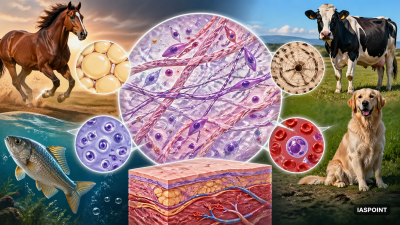
Connective tissue is the most diverse and widely distributed tissue in the animal kingdom. Derived from the embryonic mesoderm, its primary roles include binding organs together, providing structural support, and facilitating the transport of nutrients and gases. Unlike epithelial tissue, connective tissue is characterized by a high volume of extracellular matrix (ECM) with relatively few cells scattered within it.
Components of Connective Tissue
Connective tissue across species generally consists of three components:
- Cells: Such as fibroblasts (secrete fibers), mast cells (release histamine in inflammatory responses), and macrophages (phagocytic cells).
- Fibers: Including Collagen (strength), Elastin (flexibility), and Reticulin (structural framework).
- Ground Substance: A gel-like material that fills the space between cells and fibers.
Classification and Adaptations in the Animal Kingdom
Connective tissues are categorized based on the nature of the matrix and the arrangement of fibers.
1. Loose Connective Tissue
Contains fibers that are loosely woven in a semi-fluid ground substance.
- Areolar Tissue: Serves as a “packing material” between organs. In amphibians, it helps attach the skin loosely to the underlying muscles, facilitating cutaneous respiration.
- Adipose Tissue: Specialized for fat storage.
- Blubber: A thick layer of sub-cutaneous adipose tissue in marine mammals (whales, seals) used for insulation and buoyancy.
- Hump of Camel: Concentrated adipose tissue that acts as a food reserve and metabolic water source.
2. Dense Connective Tissue
Contains a higher proportion of fibers (mostly collagen), providing great tensile strength.
- Tendons: Connect skeletal muscles to bones. They are crucial for the powerful limb movements of galloping ungulates (horses, deer).
- Ligaments: Connect bone to bone. These are highly elastic in the necks of long-necked animals like giraffes to support the head.
3. Specialized Connective Tissue: Skeletal
Provides the structural framework and protects internal organs.
| Tissue Type | Composition | Animal Examples |
| Cartilage | Solid but pliable matrix (Chondrin). | Forms the entire endoskeleton of Chondrichthyes (Sharks and Rays). |
| Bone | Hard, non-pliable matrix rich in Calcium and Phosphorus. | Forms the skeleton of Osteichthyes (Bony fish), Reptiles, Birds, and Mammals. |
- Pneumatic Bones: In birds (Aves), bones are hollow and contain air cavities to reduce body weight for flight, while maintaining strength through internal struts.
4. Specialized Connective Tissue: Fluid
Responsible for the internal transport of oxygen, nutrients, and waste products.
- Blood: ” Erythrocytes (RBCs): In all non-mammalian vertebrates (Fish, Amphibians, Reptiles, Birds), RBCs are oval and nucleated. Mammals (except Camels/Llamas) have enucleated, biconcave RBCs.
- Haemoglobin: The iron-based respiratory pigment found in vertebrates.
- Haemolymph: Found in animals with open circulatory systems (Arthropods and most Mollusks).
- It lacks RBCs.
- Contains Haemocyanin (copper-based), which appears blue when oxygenated, in animals like crabs and octopuses.
- Lymph: A colorless fluid containing specialized white blood cells (lymphocytes) involved in immunity.
Unique Connective Tissue Facts for UPSC Prelims
- Dermis of Skin: The leather used commercially from animal hides is primarily the “Dense Irregular Connective Tissue” layer of the dermis.
- Vitreous Humor: The jelly-like substance in the eyes of vertebrates is a specialized form of connective tissue that maintains the shape of the eyeball.
- Notochord: In primitive chordates and embryonic stages of vertebrates, the notochord is a flexible, rod-like structure made of vacuolated cells surrounded by a fibrous sheath (a precursor to the vertebral column).
- Master Cells of Immunity: Mast cells in the connective tissue of lower vertebrates like fish are involved in the immediate response to pathogens, similar to their role in higher mammals.
- Sclera: The “white” of the eye in many animals is made of dense connective tissue; in some birds and reptiles, it contains small bones called Scleral Ossicles for added protection.
Comparative Matrix of Fluid Connective Tissue
| Feature | Mammalian Blood (Human-like) | Bird/Reptile Blood | Insect Haemolymph |
| RBC Shape | Biconcave, Circular | Oval, Elliptical | No RBCs |
| Nucleus | Absent (Enucleated) | Present (Nucleated) | N/A |
| Pigment | Haemoglobin (Iron) | Haemoglobin (Iron) | Haemocyanin (Copper) or None |
| Function | Gas/Nutrient Transport | Gas/Nutrient Transport | Nutrient Transport Only” |